Nieuws
A Ticket System for Government (Or: Let’s Finally Give the Ombudsman Teeth)
The ombudsman, as it stands, is a shark without teeth. It cannot even smell a scandal if it was bleeding before their eyes — can’t sense, can’t bite, can’t act, can’t fix. It’s a watchdog with no jaws. So let’s give it an upgrade or even better give the government such an upgrade that Ombudsman loses the necessity for their entire existence.
This isn’t some grand ideological revolution. It’s just a silly idea for a public ticket system. Silly, but powerful.
Imagine a civic ticket system — not buried in obscure forms, not locked in back-office email chains. Just like an internal help-desk, but for governance. Public, structured, traceable. And smart.
This is what it looks like.
Core Idea
Citizens should be able to report issues publicly — not buried in anonymous inboxes, not hidden behind “ongoing investigation” seals. People already talk about public issues. If people can talk about public issues with their friends, why can’t they track them together too?
A government ticket system could work just like internal systems in IT or customer service — but with a civic twist.
This is not a place for endless debate. It’s a structure to frame problem → proposal → response, cleanly and traceable.
This system proposes a transparent, iterative problem-solving interface where AI is used not to obscure, but to clarify.
The System: Public, AI-Structured, and Transparent
The system is made up of 4 stages — and yes, it uses AI — but only as a tool to help people sharpen what they’re already saying.
Every issue goes through this cycle:
1. Problem Description
a) Citizens submit an issue.
b) The AI cleans up the language, consolidates overlapping inputs, and upgrades the coherence of the report.
c) A public change-log shows the input that evolved the description — all steps visible, all input attributable.
2. Proposed Solution
a) Based on the refined problem description, the AI drafts a solution or possible action path.
b) This is visible to the public as a formal response — no magic, just structured reasoning.
c) This is not a decision. It’s a draft — structured logic, not authority. Only advice.
3. Critique Layer
a) Citizens respond to the proposed solution — a structured challenge to the proposal..
b) Their remarks are also structured by AI — not censored, but upgraded for clarity and grouped by theme or angle.
c) Again, change-logs and input trails are visible. No anonymous edits. No hidden manipulations.
d) in a sense this is the same as step 1 (problem description)
4. Upgraded Solution
a) The AI integrates valid critiques and proposes a refined version of the solution.
b) This is the “feedback-reinforced” stage, where the system attempts synthesis, not endless argument loops.
All stages remain visible — including abandoned tickets, failed resolutions, and ongoing ones. This creates a living public record of issues and proposed governance responses.
This is the synthesis. 1 = 2 + 3 = 4.
Why This Matters
- It forces clarity and traceability. No more vague complaints floating in chaos.
- It turns public input into a collaborative upgrade process.
- It shows which tickets are being handled, stalled, ignored — in plain sight.
- It makes every AI edit accountable, not mysterious.
- It doesn’t replace the ombudsman — it arms them.
Business Model? Sure — But Keep It Public
Yes, this is a product. But no, it shouldn’t be commercialized. This is civic infrastructure. It belongs to the commons.
It could be sold to municipalities, NGOs, or transparency coalitions — but that defeats the purpose.
Build it, release it, and let it run at zero cost. The public has already paid for enough systems that don’t work. This one should.
The value lies not in monetization — but in legitimacy.
Expanded Use: From Complaint Board to Administrative Operating System
What starts as a feedback tool can evolve into a complete civic engine. The system can scale:
- Reported Issue
- Processed Issue (by a public servant or automated filter)
- AI-generated remark on process adequacy (4-stages again)
- Re-open option if resolution was insufficient (4-stages again)
- Cross-department visibility and workflow mapping
- The ticket can go through different departments and the work of each department remains visible.
Each issue flows like a case file, but it’s public-facing and structurally transparent. Departments can adopt the system internally. Citizens and officials see the same state of the case. Updates are traceable.
With enough refinement, this system could even approach pre-judicial arbitration or replace lower-level administrative courts — especially for predictable, repeatable types of disputes (benefits, housing, permit denials, etc.).
At some point a judge and lawyer can then bend over the case after it went through these 3 steps.
Design Philosophy
- Public by default.
- AI-enhanced, not AI-obscured.
- Built around iteration, not resolution-hiding.
- Input is traceable. Reasoning is legible. Logic is public.
- Not built to silence citizens with forms — but to cohere chaos into clarity.
Potential Impact:
If deployed at scale, this would:
- Reduce performative complaint culture (“I ranted online!”) in favor of traceable input.
- Provide oversight journalists and watchdogs with live case data.
- Offer civil servants a way to separate noise from signal.
- Create longitudinal accountability: we’d know what failed, what improved, and why.
- We can track government efficiency through details such as backlog and amount of re-opened cases
Final Thought
Let’s stop treating public concern like noise.
Let’s give it a ticket.
Let’s give the ombudsman jaws.
Give people a way to speak clearly. Let the problems stay visible. Let the fixes be criticized. Let the system evolve in full view.
Democracy doesn’t die in darkness — it suffocates in forms. We’ve normalized arbitrary bureaucracy and opaque complaint systems. But the technology to upgrade them exists. All we’re missing is the will — and the will can be crowd-sourced.
Written by Artorius Magnus
https://tinyurl.com/laconic-utopia World-Peace suggestions @250 articles highschool dropout-autodidact (unofficially 5+ PhD's).
Pluimveebedrijf in Oldekerk geruimd om uitbraak vogelgriep
''In Oldekerk in Groningen is op een pluimveebedrijf vogelgriep van het besmettelijke type H5 vastgesteld. Om de verspreiding van het virus te voorkomen, wordt het bedrijf geruimd.
Het gaat om 36.000 vogels.''
https://nos.nl/artikel/2219502-pluimveebedrijf-in-oldekerk-geruimd-om-uitbraak-vogelgriep.html
Nog een organisatie die achter het uithongeringssysteem staat
Er is nog een grote organisatie die achter het uithongeringssysteem staat en wel de Landelijke Dierenbescherming. Vaak krijgen zij honderd duizenden euro's gedoneerd van de Postcodeloterij en hoeveel gaat er naar de dieren? Dankzij de politiek in Den Haag is het met het dierenwelzijn in de Oostvaardersplassen triest gesteld..
De Armeense genocide, 1915 (NIOD Instituut voor Oorlogs-, Holocaust- en Genocidestudies)
''In de lente van 1915 nam de Osmaanse regering maatregelen die de vervolging inzette van de Armeniërs in het Osmaanse Rijk. Aan het einde van de Eerste Wereldoorlog leefde hier nog maar een fractie van de vooroorlogse Armeense gemeenschap.
Vandaag de dag wonen er vrijwel helemaal geen Armeniërs meer in het Anatolische binnenland. Deze ruwe feiten schetsen in een notendop de complexe geschiedenis van de Armeense genocide.''
https://www.niod.nl/sites/niod.nl/files/Armeense%20genocide.pdf
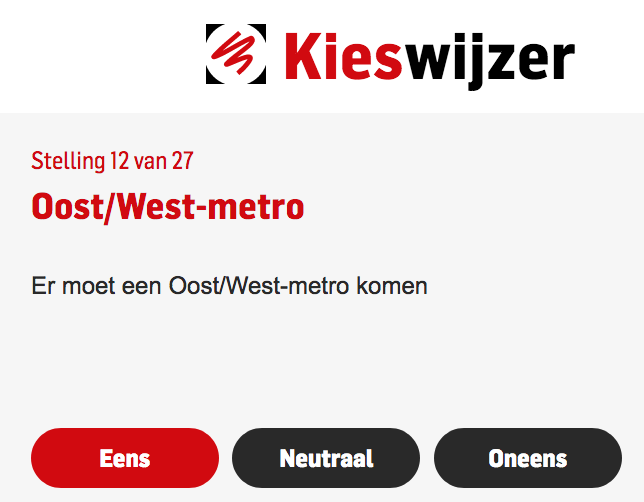
Kieswijzer Stelling 12 Er moet een Oost/West-metro komen
De Kieswijzer van Het Parool legt 27 stellingen voor om een partij voor u te suggereren om op te stemmen bij de gemeenteraadsverkiezingen. De 12e stelling zegt dat er een Oost/Westlijn moet komen.
De twee partijen die er tegen zijn vrezen dat het de gemeente teveel zal kosten en dat het ten koste zal gaan van het bestaande openbaar vervoer.
Het mag duidelijk zijn dat het vooral door Den Haag gefinancierd moet worden of door investeerders zoals pensioenfondsen die als dank daarvoor jaarlijks een klein beetje terugkrijgen uit de exploitatie. Schiphol kan ook meebetalen uit de eigen inkomsten.
De partijen erover:
Eens
- GroenLinks
- VVD
- D66
- PvdA
- SP
- CDA
- Partij van de Ouderen
- SGP
- ChristenUnie
- DENK Amsterdam
- Piratenpartij
Neutraal
- Forum voor Democratie
- BIJ1
Oneens
- Partij voor de Dieren
- 50PLUS Amsterdam
Het uithongeringssysteem van de grote grazers in de Oostvaardersplassen bereikt zijn hoogtepunt
Het uithongeren van de grote grazers in de Oostvaardersplassen bereikt zijn hoogtepunt. Vanaf 26 februari 2018 is een enorme vrieskou aangezegd en dat zal fataal zijn voor de overige verzwakte grazers Deze winter zal er een crash plaats vinden met ruw geschat 3000 - 3500 door honger en kou gecrepeerde dieren.
De Partij voor de Dieren landelijk, staat achter dit uithongeringssysteem, (want voor hen is dit NATUUR) en in Provinciale Staten Flevoland zijn het de PvdD, maar ook GroenLinks en de Partij van de Arbeid die dit uithongeringssysteem ondersteunen
Kamerleden bedreigd om erkenning Armeense genocide
''Vijf Turks-Nederlandse politici hebben last van bedreigingen nadat Turkije's grootste krant hen als landverraders bestempelde. Regeringskrant Sabah noemt het schandalig dat de politici van Turkse afkomst instemden met het voorstel de massamoord op Armeniërs te erkennen als genocide.''
Het Parool: De Noord/Zuidlijn smaakt naar meer
Amsterdam heeft met de komst van de Noord/Zuidlijn vanaf deze zomer meer metro, maar is het genoeg? Moet er niet ook een oost-westelijke verbinding komen om de groeiende stad te kunnen bijbenen? Als je het Amsterdamse metronetwerk opnieuw zou uitvinden, weet je één ding zeker: het zou een totaal andere vorm hebben dan het netwerk zoals we dat nu kennen. (...) Lees verder
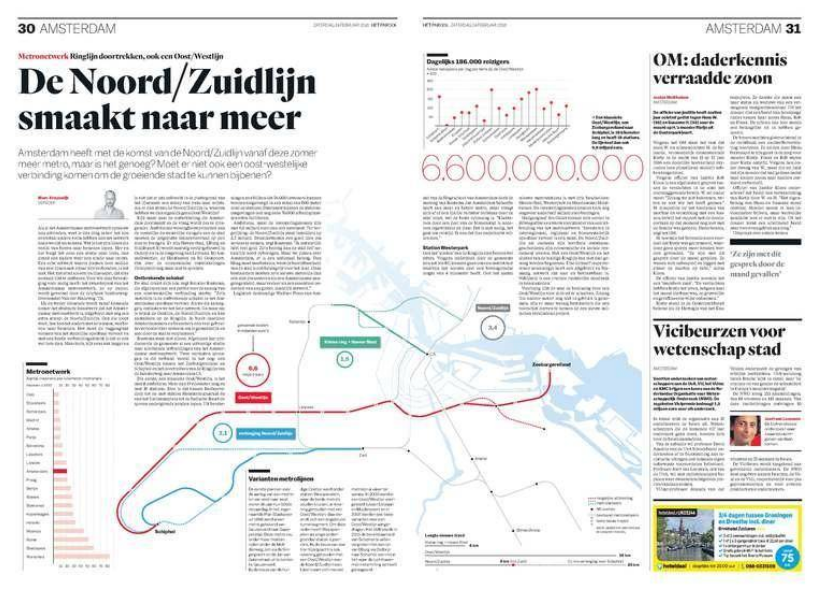
"De stad draait zich om, zegt Reinder Rustema, die afgelopen jaar een petitie voor de aanleg van een oost-westelijke verbinding startte.
"Zo'n metrolijn is de ontbrekende schakel in het Amsterdamse openbaar vervoer. Als we die aanleggen, ontlasten we het hele netwerk. Ga maar na: je kruist de Oostlijn, de Noord/Zuidlijn en kan aantakken op de Ringlijn. Je biedt daardoor Amsterdammers en bezoekers een veel gebruikersvriendelijker systeem om je gemakkelijk en snel door de stad te verplaatsen."
NRC: Hoe je kratten en bloembakken maakt uit plastic prut
Recycling In 2030 moeten alle plastic verpakkingen te recyclen zijn tot tuinmeubelen of emmers. Gaat dit lukken? (...) Lees verder
Duidelijk is in ieder geval wel dat recycling nu niet goed gaat.
Statiegeld zou dat enorm verbeteren!