Updates
A Ticket System for Government (Or: Let’s Finally Give the Ombudsman Teeth)
The ombudsman, as it stands, is a shark without teeth. It cannot even smell a scandal if it was bleeding before their eyes — can’t sense, can’t bite, can’t act, can’t fix. It’s a watchdog with no jaws. So let’s give it an upgrade or even better give the government such an upgrade that Ombudsman loses the necessity for their entire existence.
This isn’t some grand ideological revolution. It’s just a silly idea for a public ticket system. Silly, but powerful.
Imagine a civic ticket system — not buried in obscure forms, not locked in back-office email chains. Just like an internal help-desk, but for governance. Public, structured, traceable. And smart.
This is what it looks like.
Core Idea
Citizens should be able to report issues publicly — not buried in anonymous inboxes, not hidden behind “ongoing investigation” seals. People already talk about public issues. If people can talk about public issues with their friends, why can’t they track them together too?
A government ticket system could work just like internal systems in IT or customer service — but with a civic twist.
This is not a place for endless debate. It’s a structure to frame problem → proposal → response, cleanly and traceable.
This system proposes a transparent, iterative problem-solving interface where AI is used not to obscure, but to clarify.
The System: Public, AI-Structured, and Transparent
The system is made up of 4 stages — and yes, it uses AI — but only as a tool to help people sharpen what they’re already saying.
Every issue goes through this cycle:
1. Problem Description
a) Citizens submit an issue.
b) The AI cleans up the language, consolidates overlapping inputs, and upgrades the coherence of the report.
c) A public change-log shows the input that evolved the description — all steps visible, all input attributable.
2. Proposed Solution
a) Based on the refined problem description, the AI drafts a solution or possible action path.
b) This is visible to the public as a formal response — no magic, just structured reasoning.
c) This is not a decision. It’s a draft — structured logic, not authority. Only advice.
3. Critique Layer
a) Citizens respond to the proposed solution — a structured challenge to the proposal..
b) Their remarks are also structured by AI — not censored, but upgraded for clarity and grouped by theme or angle.
c) Again, change-logs and input trails are visible. No anonymous edits. No hidden manipulations.
d) in a sense this is the same as step 1 (problem description)
4. Upgraded Solution
a) The AI integrates valid critiques and proposes a refined version of the solution.
b) This is the “feedback-reinforced” stage, where the system attempts synthesis, not endless argument loops.
All stages remain visible — including abandoned tickets, failed resolutions, and ongoing ones. This creates a living public record of issues and proposed governance responses.
This is the synthesis. 1 = 2 + 3 = 4.
Why This Matters
- It forces clarity and traceability. No more vague complaints floating in chaos.
- It turns public input into a collaborative upgrade process.
- It shows which tickets are being handled, stalled, ignored — in plain sight.
- It makes every AI edit accountable, not mysterious.
- It doesn’t replace the ombudsman — it arms them.
Business Model? Sure — But Keep It Public
Yes, this is a product. But no, it shouldn’t be commercialized. This is civic infrastructure. It belongs to the commons.
It could be sold to municipalities, NGOs, or transparency coalitions — but that defeats the purpose.
Build it, release it, and let it run at zero cost. The public has already paid for enough systems that don’t work. This one should.
The value lies not in monetization — but in legitimacy.
Expanded Use: From Complaint Board to Administrative Operating System
What starts as a feedback tool can evolve into a complete civic engine. The system can scale:
- Reported Issue
- Processed Issue (by a public servant or automated filter)
- AI-generated remark on process adequacy (4-stages again)
- Re-open option if resolution was insufficient (4-stages again)
- Cross-department visibility and workflow mapping
- The ticket can go through different departments and the work of each department remains visible.
Each issue flows like a case file, but it’s public-facing and structurally transparent. Departments can adopt the system internally. Citizens and officials see the same state of the case. Updates are traceable.
With enough refinement, this system could even approach pre-judicial arbitration or replace lower-level administrative courts — especially for predictable, repeatable types of disputes (benefits, housing, permit denials, etc.).
At some point a judge and lawyer can then bend over the case after it went through these 3 steps.
Design Philosophy
- Public by default.
- AI-enhanced, not AI-obscured.
- Built around iteration, not resolution-hiding.
- Input is traceable. Reasoning is legible. Logic is public.
- Not built to silence citizens with forms — but to cohere chaos into clarity.
Potential Impact:
If deployed at scale, this would:
- Reduce performative complaint culture (“I ranted online!”) in favor of traceable input.
- Provide oversight journalists and watchdogs with live case data.
- Offer civil servants a way to separate noise from signal.
- Create longitudinal accountability: we’d know what failed, what improved, and why.
- We can track government efficiency through details such as backlog and amount of re-opened cases
Final Thought
Let’s stop treating public concern like noise.
Let’s give it a ticket.
Let’s give the ombudsman jaws.
Give people a way to speak clearly. Let the problems stay visible. Let the fixes be criticized. Let the system evolve in full view.
Democracy doesn’t die in darkness — it suffocates in forms. We’ve normalized arbitrary bureaucracy and opaque complaint systems. But the technology to upgrade them exists. All we’re missing is the will — and the will can be crowd-sourced.
Written by Artorius Magnus
https://tinyurl.com/laconic-utopia World-Peace suggestions @250 articles highschool dropout-autodidact (unofficially 5+ PhD's).
1.895 ondertekeningen!!
Wow bijna 2000!. Kom op mensen.
De concept brief naar de Statengriffie en Gedeputeerde Staten staat al klaar. Voorlopig blijft de petitie open voor meer ondersteuning. Bedankt alvast. gr Bart.
Petitie sluit definitief.
Er is sinds mei 2026 een nieuwe petitie "Erken thuisonderwijs als onderwijsvorm". https://erkenthuisonderwijs.petities.nl
Het verzoek aan jullie om deze nieuwe petitie te ondertekenen, gezien de gewijzigde politiek maatschappelijke situatie (kamerbrief OCW dec 2025 en besluit Hoge Raad)..
Super nog nieuwe ondertekenaars!!
Op 11 mei 2026 om 19.00 uur vindt het overhandigen van de petitie plaats in de foyer of op het binnenplein van het raadshuis in Voorburg. Het adres van Huize Swaensteyn is Herenstraat 72-74, 2271 CK te Voorburg.
Wees allen welkom.
Hartelijk dank voor uw steun voor de petitie
Beste ondertekenaars,
Hartelijk dank voor uw steun voor de petitie "Stop de vrijheidsbijdrage als verborgen belastingverhoging voor burgers" We zijn met 107 ondertekenaars uit het hele land die allemaal vinden dat de hoge vrijheidsbijdrage van het kabinet niet door mag gaan.
Dinsdagmiddag 19 mei 2026 om 13.45 _ 14.00 gaan in ieder geval 4 van ons uit Nijmegen naar Den Haag om deze petitie aan te bieden aan de vaste Tweede Kamercommissie van Defensie onder voorzitterschap van Jan Paternotte (D66). Als u ons wil ondersteunen moet u voor volgende week aan mij doorgeven. We moeten vanwege de beveiliging alle namen door geven en maximaal 8 deelnemers.
We houden u op de hoogte hoe het verder gaat met de petitie over vrijheidsbijdrage.
met vriendelijke groet.
Mustafa Balugo en Joris Leijten Nijmegen, .
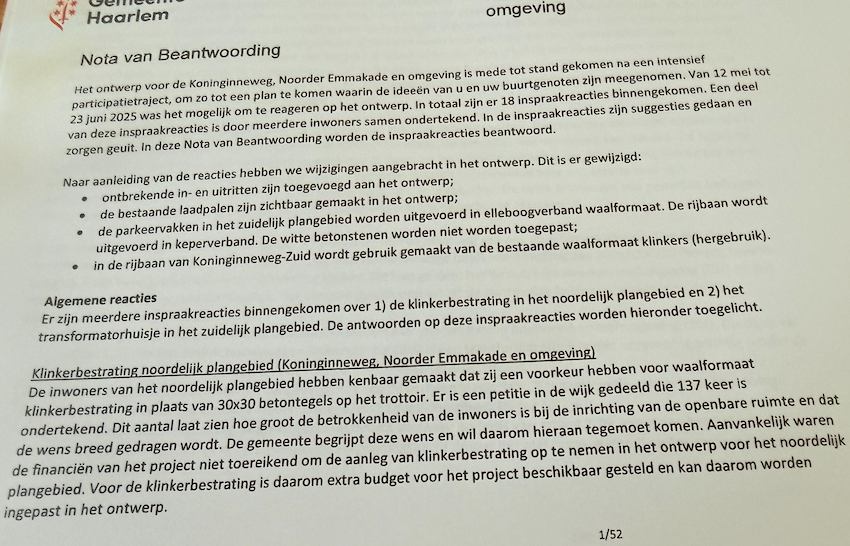
Antwoord van gemeente over klinkerbestrating KNEK-Noord (noordelijk gedeelte Koninginnebuurt)
U hebt onze petitie gesteund om in KNEK-Noord klinkerbestrating te realiseren in plaats van de huidige grijze tegel terug te leggen. En, met u 137 anderen.
In de raadvergadering van 21 april jongstleden is het definitieve ontwerp aangenomen en daarin is extra budget beschikbaar gesteld om de klinkerbestrating te realiseren. De gemeente schrijft:
Er is een petitie in de wijk gedeeld die 137 keer is ondertekend. Dit aantal laat zien hoe groot de betrokkenheid van de inwoners is bij de inrichting van de openbare ruimte en dat de wens breed gedragen wordt. De gemeente begrijpt deze wens en wil daarom hieraan tegemoet komen. Aanvankelijk waren de financiën van het project niet toereikend om de aanleg van klinkerbestrating op te nemen in het ontwerp voor het noordelijk plangebied.
Voor de klinkerbestrating is daarom extra budget voor het project beschikbaar gesteld en kan daarom worden ingepast in het ontwerp.
Wij zijn natuurlijk zeer gelukkig met deze uitkomst en nemen aan dat u dat ook bent. Nogmaal, hartelijk dank voor uw steun.
Met vriendelijke groeten, Klankbordgroep KNEK-Noord
Meer dan 1100 ondertekeningen!
Meer dan 1100 ondertekeningen! is mooi, en toch weten we dat er miljoenen mensen zijn die katten hebben. Kom op! Onderteken mee.
er is een nieuwe petitie Erken thuisonderwijs als onderwijsvorm
sinds 6 mei 2026 is er een nieuwe petitie met het adres https://erkenthuisonderwijs.petities.nl.
Op naar de 250! Gemeenteraadslid stelt al vragen
Gemeenteraadslid Tjeerd Ritmeester van Eindhoven voor elkaar, heeft naar aanleiding van onze petitie al vragen gesteld hierover aan de wethouder. Helaas om het op de officiële agenda van de gemeenteraad te krijgen moeten we 250 ondertekenaars hebben.
Kortom deel de link met je familie, vrienden en vage honden kennissen en laten we dit doel zsm halen. Vergeet niet met de link in de bevestigingsemail je ondertekening definitief te maken (soms duurt dit iets langer om te ontvangen of beland deze in je spam)