Nieuws
Petitie overhandigd!
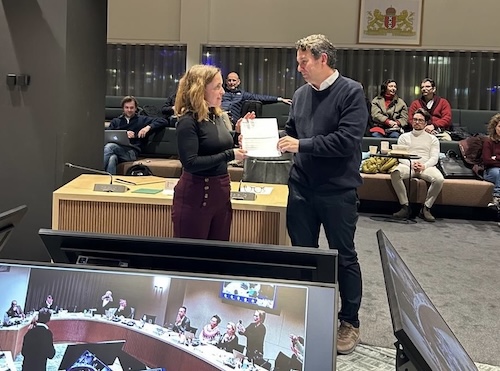
Vanavond heeft de stadsdeelcommissie en -bestuur de petitie ontvangen. Stadsdeelbestuurder Ester Fabriek nam de petitie aan tijdens het inspreken door bewoners met de suggestie op de schermen. De opnames zijn terug te zien via de tijdelijke locatie van de vergaderingen in Nieuw-West.
De Werkgroep Blackspots heeft dit voorstel ook ontvangen. Dit voorstel, samen met hun adviezen, de steun hiervoor van het stadsdeel en het vinden van budget moet de situatie verbeteren.
Met hulp van een tegendenker uit de buurt zijn de onderstaande antwoorden op vragen voorbereid. Die niet allemaal gesteld werden:
Maar de auto's die in het park moeten zijn dan?
Een heel klein stukje verderop het park in, na de portiersloge, is het de norm dat je met alarmlichten aan en 5km/u voorzichtig tussen de voetgangers rijdt. Dat kan heel goed op de brug al beginnen. Laat de auto's vanaf de Haarlemmerweg over een verlaagde stoeprand een voetgangerszone inrijden als ze hier afslaan. Via de andere ingang binnenkomen is beter natuurlijk.
Want nu lijkt het een reguliere afslag, geregeld met verkeerslichten, het is uitnodigend. Dat veroorzaakt ook allerlei autoverkeer. Automobilisten van buiten Amsterdam denken dat je hier met de auto goed kan komen. Terwijl ze er heel ongewenst zijn en ook vaak door de portier weer doorgestuurd worden naar de parkeergarage. Autonavigatie stuurt automobilisten die een bestemming in het park opgeven via deze ingang het park in, alsof ze er helemaal kunnen komen. De portier moet ze dan weer wegsturen naar de parkeergarage bij de Praxis. Als de brug voet- en fietspad wordt hoort daar een verkeersbesluit bij en die worden geautomatiseerd overgenomen door Google, Tomtom en dergelijke. Computer zegt dan wèl nee.
Maar de taxi's die er nu vaak rijden dan?
Van alle mensen die over de brug gaan is het merendeel voetganger of fietser. Duizenden op een dag, dus die moeten dan ook de bijbehorende voorrang krijgen. Behalve tijdens evenementen komen taxi's vooral over de brug om daar buiten een parkeervak te wachten op een oproep, niet om iemand af te zetten of op te halen. En als er incidenteel eens een keer een hotelgast met koffers of een gast voor de tv-studio afgezet moet worden dan kan de taxi gewoon met alarmlichten met 5km/u over de brug. Hotel of televisie-redactie moet maar een instructie toesturen, dat is het nadeel van deze toplocatie. Misschien moet er een taxi-standplaats op de Haarlemmerweg komen, want officieel is de ruimte geen standplaats.
De logische plek voor automobilisten om te stoppen voor het park moet bij het stoplicht op de Haarlemmerweg worden. Dan kunnen passagiers tijdens het wachten voor het rode licht uitstappen.
Komen de hulpdiensten niet in de problemen als autoverkeer niet meer door de Van Limburgstirumstraat mag?
Het is onveilig voor fietsers om zo'n doorgang met paaltjes onmogelijk te maken voor autoverkeer. De Fietsersbond zegt ook altijd paaltjes te mijden, gevaarlijk voor fietsers. Als er geen paaltjes staan kunnen auto's met een blauw zwaailicht op het dak gewoon over dat brede fietspad rijden. Vaak gebeurt het niet omdat het dan gaat om hulpverleners die in of uit deze wijk gaan. De meeste rijden over de Haarlemmerweg. Met een goede inrichting zal autoverkeer dat de Van Limburgstirumstraat inrijdt vanaf het plein linksaf worden geleid, de Joan Melchiorstraat in.
Er is een ingang van een ondergrondse parkeergarage in dat stukje van de Van Limburgstirumstraat, wordt die onbereikbaar?
Die is een stukje de straat in. De auto's voor die parkeergarage laat je over het brede fietspad rijden dat vanaf de garage-ingang pas officieel een fietspad wordt voor het laatste stuk. Ter hoogte van de Joan Melchiorstraat staat er dan al een bord 'doodlopende weg' en 'fietspad over 30 meter" met de suggestie om die straat in te slaan. Het is dan alleen de laatste 15 meter tot aan de Haarlemmerweg een officieel fietspad met rood asfalt en borden erbij enzo. Maar dat is genoeg om het verkeer op de Haarlemmerweg de afslag deze straat in te ontnemen.
Vanaf de Haarlemmerweg is er dan voor automobilisten geen enkele suggestie meer dat ze af kunnen slaan. Nu mogen ze dat al niet trouwens, maar dan zullen ze het nog minder doen dan nu. Het ziet er nu nog wel te uitnodigend uit. De overtreders van verkeersregels doen dat gek genoeg ook altijd op volle snelheid, alsof het dan minder erg is.
Hoe kan je garanderen dat bestuurders niet alsnog in- en uitrijden?
Bij tunnels, bruggen, stegen en dergelijke zijn heel goed mobiele handhavingscamera's te plaatsen. Nu kan dat niet goed op deze plek, maar als elke auto die hier in of uit rijdt voortaan in overtreding is dan is dat een goede plek voor zo'n camera af en toe. Vooral als er kennelijk veel overtredingen zijn en auto's over het fietspad zullen rijden.
Dat is trouwens een behoorlijke overtreding, met een auto over een druk fietspad rijden. Je riskeert een conflict met een fietser en die kan je met je auto nooit snel genoeg achterhalen om je schade te verhalen. Ik betwijfel of veel automobilisten het zullen doen. Ze hebben dan het toekomstige bord 'doodlopende straat over 50m' bij het Van Limburgstirumplein (voor Doardi) gemist. En ook een bord en de weginrichting waarmee ze de Joan Melchiorstraat in worden gestuurd. De weginrichting zegt dan nee. Nu zegt die ja.
Als auto's omrijden, veroorzaakt dat dan niet meer vervuiling?
Een brandstofauto is vervuilend zodra die gaat rijden. Op de gemiddelde afstand van een autoritje is dit stukje extra minimaal, vergelijkbaar met de motor stationair laten draaien om op je telefoon te klooien. De meeste automobilisten zullen hun routines en routes aanpassen. De enige automobilisten die iets meer zullen rijden wonen ten noorden van het Van Limburgstirumplein. De rest rijdt ofwel evenwijdig aan de Haarlemmerweg naar de Van Hallstraat (stad uit) ofwel enkele tientallen meters om via de Van der Hoop en Van der Duijnstraat (centrum in). Maar juist de omwonenden die niet meer makkelijk de Haarlemmerweg in kunnen draaien hebben ook het meeste profijt van deze ingreep als ze niet in de auto rijden.
Als auto's omrijden, wordt de kans op ongelukken dan niet groter?
De twee andere kruisingen met de Haarlemmerweg zijn veiliger. Die met de Van Hallstraat is recent verbeterd. Die met de Van Der Duijnstraat heeft de status van een uitrit en moet al het verkeer voorrang geven totdat er niets meer aankomt. Ook is die niet zo onoverzichtelijk als de kruising met de Van Limburgstirumstraat nu, waar de grote stromen voetgangers en fietsers doorheen gaan.
Mensen klagen nu al over een onbereikbare buurt, hoe zorg je dat de wijk bereikbaar blijft voor bewoners?
Dan bedoelen ze vast bereikbaar voor automobilisten. De buurt is en blijft heel goed bereikbaar voor mensen. Nu al heeft de Van Limburgstirumstraat eenrichtingsverkeer vanaf de Haarlemmerweg. Dus de wijk in verandert er niets voor automobilisten. Wel wordt het duidelijker. De wijk uit wordt het omrijden naar de Van Hall. Richting centrum de Van der Duijnstraat. De gemeente kan een telling houden om hoeveel auto's het gaat en of de infrastructuur het aan kan.
In ruil daarvoor wordt deze plek veel rustiger en veiliger, want vooral 's avonds en 's nachts wordt er af en toe snel gereden omdat de asfaltweg daartoe uitnodigt. Een Van der Duijnstraat zal dat veel minder doen. Die is alleen te vinden met navigatie, het meeste verkeer zal via de Van Hall gaan.
Eigenlijk is het gek dat zowel de Van Limburgstirumstraat als de Van der Duijnstraat auto's op de Haarlemmerweg laten uitkomen. Tussen beide straten zit maar 100 meter.
Waarom kunnen we niet gewoon drempels plaatsen? Wat maakt de Haarlemmerweg veiliger als we de Limburg van Stirumstraat afsluiten? De ongelukken gebeuren op de Haarlemmerweg: mensen die van het park naar de Stirumstraat fietsen.
De onduidelijke situatie op deze kruising is de kern van het probleem. Als auto's geen optie meer hebben om af te slaan en alleen stoppen om fietsers en voetgangers over te laten steken wordt het veel overzichtelijker voor iedereen. Auto's stoppen om fietsers en voetgangers over te laten steken die allemaal tegelijk oversteken van links en rechts. Als de fietsers en voetgangers rood hebben (op de brug en vanuit de Van Limburgstirumstraat) hebben de automobilisten op de Haarlemmerweg groen. En andersom.
Brief aan de voorzitter van de Vaste Kamercommissie Volksgezondheid, Welzijn en Sport.
Parliament of the Kingdom of the Netherlands House of Representatives Committee for Health, Welfare and Sports
For the attention of: Mrs Helma Lodders, Committee chair
4th March 2019
Dear Mrs Lodders,
Tobacco Harm Reduction and the Dutch National Prevention Agreement: Letter from 36 International Experts and Academics in Tobacco Control.
We are a group of nicotine, tobacco and addiction researchers, health professionals, and tobacco control policy experts in support of tobacco harm reduction as part of comprehensive tobacco control. We respectfully write to you in view of the upcoming debate in the Dutch Lower House about the National Prevention Agreement (1) - a topic which has generated significant interest among researchers, health professionals and experts working in tobacco control policy in Europe and across the globe.
We very much welcome the objectives and existing tobacco control measures set out in the Agreement which are in line with the WHO Framework Convention on Tobacco Control.
Any policy intervention that reduces smoking in the Netherlands has our full support. We regret however, that the Agreement fails to acknowledge the important role that products that do not involve combustion and inhalation of smoke can play in reducing the harms caused by smoking. Such products include forms of low nitrosamine smokeless tobacco such as snus, vaping technologies and pharmaceutical or pure nicotine products. From a health perspective, the major distinction between nicotine products is whether they are combustible or non-combustible. It is well known that it is the smoke, not the nicotine, which causes almost all of the smoking related diseases and non-combustible products have a clear role to play in reducing smoking prevalence to meet the ambitious objectives set out in the Agreement.
The public health opportunities for harm reduction are vast, and in the case of vaping (e-cigarettes) these have been well described by the Royal College of Physicians of London (RCP) in its thorough April 2016 report (2) and more recently by McNeil el al. (2018) in a report to Public Health England (3). For example, on the subject of relative risk, based on smoke and vapour toxicology the RCP stated:
"Although it is not possible to precisely quantify the long-term health risks associated with e-cigarettes, the available data suggest that they are unlikely to exceed 5% of those associated with smoked tobacco products, and may well be substantially lower than this figure". (5.5)
On the subject of smoking cessation, there is increasing evidence from Randomised Controlled Trials (RCT) that have been designed specifically to explore effects on tobacco smoking, that vaping products (e-cigarettes) can help smokers to stop smoking. A Cochrane review published in 2016 concluded that smokers using an e-cigarette were more likely to quit compared to those using a placebo at 6 months (4). More recently, a RCT of e-cigarettes versus Nicotine Replacement Therapy (NRT) alongside behavioural support in England, reported an almost two-fold increase in 12 month quit rates with e-cigarettes (5).
On the question of what the products are being used for, the RCP is clear they are alternatives to smoking and used primarily by smokers to reduce their health risks.
“…the available evidence to date indicates that e-cigarettes are being used almost exclusively as safer alternatives to smoked tobacco, by confirmed smokers who are trying to reduce harm to themselves or others from smoking, or to quit smoking completely. “
Similarly, in a recent review of findings from five large-scale surveys of 60,000 young people in the United Kingdom (6) although some experimentation was reported, regular use remained very low, ranging from 0.1 to 0.5%. Recent survey data from the UK suggests this pattern has not changed7. The report conclude that:
“…surveys across the UK show a consistent pattern: most e-cigarette experimentation does not turn into regular use, and levels of regular use in young people who have never smoked remain very low.”
As is the case across the globe, in the Netherlands there are many smokers that are unable or unwilling to quit, not least of all, the poorest and most disadvantaged in society who find smoking cessation the most difficult. This large group, including those suffering from mental illness, would benefit from switching to smoke-free products. In this regard it is critical that adult smokers can be informed about these innovative products and receive non-misleading information about their relative risk.
However subjecting e-cigarettes and other smoke-free products to the same restrictions as for combustible cigarettes can have unintended consequences and can favour the tobacco industry. For example, treating vaping the same as smoking in public places has no scientific basis but could discourage smokers from using a less risky product, causing harm to health by perpetuating smoking and rewarding the cigarette trade. Advertising display bans for e-cigarettes similarly favour the incumbent product (cigarettes) and form a barrier to the much less risky innovative new products. The RCP recognises the potential for unintended consequences and states that:
“However, if [a risk-averse, precautionary] approach also makes e-cigarettes less easily accessible, less palatable or acceptable, more expensive, less consumer friendly or pharmacologically less effective, or inhibits innovation and development of new and improved products, then it causes harm by perpetuating smoking.” (Section 12.10 page 187)
Whilst we welcome tighter restrictions on cigarette smoking, treating non-combustible products such as e-cigarettes in the same way, sends the wrong message that smoke-free products are as harmful as cigarettes. This will discourage smokers from switching, which leads to the unintended consequence that cigarette use is prolonged. Obviously this goes against the Agreement’s objective to eradicate smoking.
We respectfully request that the Lower House carefully assess the role that non-combustible products such as e-cigarettes can play in reducing tobacco smoking and recommend an exemption for e-cigarettes from the bans on display/advertisement and smoking in public places. We are more than willing to provide you with further information and our perspective on the international developments in the field of tobacco harm reduction and draw your attention to recent letter to the World Health Organisation (WHO) from 72 specialists in the field (8) which offers some guiding principles for consideration for the Framework Convention on Tobacco Control (FCTC). We would welcome the opportunity to contribute to a round-table in your Committee should you decide to organize such type of event.
We confirm that signatories report no conflicts with respect to FCTC Article 5.3 and no financial conflicts of interest with respect to tobacco or e-cigarette companies under the International Committee of Medical Journal Editors (UCJME) reporting standard.
Yours sincerely,
David B Abrams PhD. Professor Dept of Social and Behavioral Sciences NYU College of Global Public Health New York University. United States
Frank Baeyens,PhD Professor Faculty of Psychology and Educational Sciences KU Leuven Belgium
Clive Bates, MA, MSc Director, Counterfactual Consulting Former Director, Action on Smoking and Health UK London United Kingdom
Linda Bauld, BA PhD FHEA FRCPE Bruce and John Usher Chair in Public Health Usher Institute University of Edinburgh Deputy Director, UK Centre for Tobacco & Alcohol Studies Honorary Professor, University of Stirling United Kingdom
Ron Borland PhD, FASSA
Nigel Gray Distinguished Fellow in Cancer Prevention,
The Cancer Council Victoria,
Melbourne Vic 3004
Australia
Thomas H. Brandon, Ph.D. Department Chair and Program Leader, Health Outcomes and Behavior Moffitt Distinguished Scholar Director, Tobacco Research & Intervention Program Moffitt Cancer Center Professor, University of South Florida Departments of Psychology and Oncologic Sciences
Pasquale Caponnetto Professor of Clinical and General Psychology Center of Excellence for the acceleration of HArm Reduction – CoEHAR University of Catania via S. Sofia 78, Catania, Italy
Sharon Cox, PhD Research Fellow Centre for Addictive Behaviours Research School of Applied Sciences London South Bank University United Kingdom
Lynne Dawkins, PhD
Associate Professor
Centre for Addictive Behaviours Research
School of Applied Sciences
London South Bank University
United Kingdom
Jean-François Etter, PhD
Professor of Public Health
Institute of Global Health
Faculty of Medicine
University of Geneva
Switzerland.
Konstantinos Farsalinos, MD, MPH Researcher Onassis Cardiac Surgery Center National School of Public Health University of Patras, Greece
Stuart Ferguson
Associate Professor
Division of Medicine, School of Medicine
College of Health and Medicine
University of Tasmania
Private Bag 34
Hobart 7001
Tasmania
William T. Godshall, MPH Executive Director Smokefree Pennsylvania 1926 Monongahela Avenue Pittsburgh, PA 15218 412-351-5880 United States
Peter Hajek, PhD Professor of Clinical Psychology Director, Tobacco Dependence Research Unit Wolfson Institute of Preventive Medicine, Queen Mary University of London United Kingdom
Jacques Le Houezec, PhD Independent consultant in Public Health & Tobacco dependence - Smoking Cessation Specialist Rennes, France. Honorary Clinical Associate Professor, UK Centre for Tobacco and Alcohol Studies, School of Medicine, University of Nottingham, UK.
Jason Hughes, PhD Professor and Head of School of Media, Communication and Sociology University of Leicester Leicester, LE1 7LA United Kingdom
Sarah Jackson, PhD CPsychol Senior Research Associate UCL Tobacco and Alcohol Research Group Department of Behavioural Science and Health University College London United Kingdom
Martin J Jarvis, DSc OBE Emeritus Professor of Health Psychology Department of Behavioural Science & Health University College London United Kingdom
Leon Kosmider, PhD, PharmD Research Assistant Professor Technical Director, Bioanalytical Shared Resource Laboratory School of Pharmacy Department of Pharmaceutics Virginia Commonwealth University Richmond United States
Lynn T. Kozlowski, PhD Professor of Community Health and Health Behavior Former Dean School of Public Health and Health Professions University at Buffalo, State University of New York New York United States
Christopher E. Lalonde, PhD
Professor of Psychology
University of Victoria
British Columbia
Canada
Karl E Lund, PhD Senior Researcher Norwegian Institute of Public Health Oslo, Norway
Colin Paul Mendelsohn, MB BS (Hons) Conjoint Associate Professor School of Public Health and Community Medicine University of New South Wales Sydney Australia
Bernhard-Michael Mayer, PhD Professor of Pharmacology and Toxicology Institute of Pharmaceutical Sciences Karl-Franzens-Universität Graz Austria
Fares Mili, MD, CTTS Addictologyst & Pulmonologyst Chairman Tunisian Society of Tobacology and Addictive Behaviours (STTACA) Tunisia
Caitlin Notley, PhD Senior Lecturer in Mental Health Addictions Research Group Norwich Medical School University of East Anglia Norwich United Kingdom
Konstantinos Poulas, PhD
Associate Professor
Department of Pharmacy University of Patras
Head of the Institute NoSmoke.Team
Patras Science Park
Greece
Lars M. Ramström, PhD Principal Investigator Institute for Tobacco Studies Täby, Sweden
Louise Ross
Clinical Consultant National Centre for Smoking Cessation
Training
Dorchester
United Kingdom
Lion Shahab, PhD Associate Professor Department of Behavioural Science and Health University College London United Kingdom
Andrzej Sobczak, PhD Head of Department of General and Inorganic Chemistry Medical University of Silesia Sosnoiwec, Jagiellonska 4, Poland
Roberto A Sussman, PhD Department of Gravitation and Field Theories Institute for Nuclear Research, National Autonomous University of Mexico, ICN-UNAM Representing Pro-Vapeo Mexico AC Mexico
David Sweanor, JD Chair of Advisory Board of the Center for Health Law, Policy and Ethics University of Ottawa Canada
Umberto Tirelli MD Professor Director, Cancer Center Clinica Mede Sacile Italy
Robert West, PhD Professor of Health Psychology and Director of Tobacco Studies Department of Behavioural Science and Health University College London United Kingdom
Alex Wodak AM, Emeritus Consultant, Alcohol and Drug Service, St Vincent's Hospital President, Australian Drug Law Reform Foundation Director, Australia21 Darlinghurst, NSW, 2010, Australia
References
National Prevention Agreement: https://www.rijksoverheid.nl/documenten/convenanten/2018/11/23/nationaal-preventieakkoord
Royal College of Physicians (London), Nicotine without smoke: tobacco harm reduction. 28 April 2016 https://www.rcplondon.ac.uk/projects/outputs/nicotine-without-smoke-tobacco-harm-reduction-0
McNeil, A., Brose, LS., Calder, R., Bauld, L. & Robson, D. (2018). Evidence review of e-cigarettes and heated tobacco products 2018. A report commissioned by Public Health England.
https://www.gov.uk/government/publications/e-cigarettes-and-heated-tobacco-products-evidence-reviewHartmann-Boyce, J., McRobbie, H., Bullen, C., Begh, R., Stead, L.F. & Hajek, P. (2016). Electronic cigarettes for smoking cessation. Cochrane Database of Systematic Reviews, Issue 9, Art. No.: CD010216. https://www.cochrane.org/CD010216/TOBACCO_can-electronic-cigarettes-help-people-stop-smoking-and-are-they-safe-use-purpose
Hajek, P., Phillips, A., Przulj, D., Pesola, F., Myers Smith, K., Bisal, N., Li, J., Parrott, S., Sasieni, P., Dawkins, L., Ross, L., Goniewicz, M., Wu, Q. & McRobbie, H. (2019). A randomized trial of e-cigarettes versus nicotine-replacement therapy. New England Journal of Medicine, Jan 30. DOI: 10.1056/NEJMoal808779.
https://www.nejm.org/doi/full/10.1056/NEJMoa1808779Bauld, L ., MacKintosh, AM., Eastwood, B., Ford, A., Moore, G., Dockrell, M., Arnott, D., Cheeseman, H. & McNeill, A. (2017). Young people’s use of e-cigarettes across the United Kingdom: findings from five surveys 2015-2017. International Journal of Environmental Research and Public Health, 14 (9), 973. https://www.mdpi.com/1660-4601/14/9/973
McNeil, A., Brose, LS., Calder, R., Bauld, L. & Robson, D. (2019). Vaping In England: an evidence update February 2019. A report commissioned by Public Health England. London: Public Health England. https://www.gov.uk/government/publications/vaping-in-england-an-evidence-update-february-2019
Letter from seventy-two specialists in nicotine science, policy and practice.
https://clivebates.com/documents/WHOCOP8LetterOctober2018.pdf
Mijlpaal
Op 26 augustus 2019 heeft de petitie de 4.600 grens doorbroken. Dank allemaal voor de steun voor de strijd tegen de verstening van de Parkhaven!.
Van de FNV pagina, waarom de actie op 2 september hard nodig is.
bron: https://www.fnv.nl/cao-sector/zorg-welzijn/jeugdzorg/actie-en-cao-pagina-jeugdzorg/geplande-acties/2-september-staking-in-den-haag
"Waarom is staken en actievoeren nodig? De vraag naar jeugdzorg wordt steeds groter. Je bent veel werktijd kwijt aan administratie.
Je hebt te weinig tijd, budget en middelen voor je cliënten. Je kunt je niet verder ontwikkelen en er is geen ruimte voor innovatie. Het werk in de jeugdzorg wordt steeds onaantrekkelijker en daardoor komt er ook geen nieuw personeel meer bij. Je werkdruk is alsmaar hoger geworden. Niet zo vreemd dus, dat je het werk in de jeugdzorg niet meer aankunt of ander werk gaat zoeken. En dat wil je eigenlijk helemaal niet, want je hebt het mooiste beroep op aarde.
Zo kunnen we niet verder Zelfs Jeugdzorg Nederland geeft aan dat het zo echt niet verder kan gaan. De zorg staat zo onder druk dat de kwaliteit van de hulp niet meer vanzelfsprekend is. De situatie is voor medewerkers én cliënten niet meer verantwoord.
Eenmalig extra geld voor jeugdzorg is niet genoeg De jeugdzorg krijgt in 2019 eenmalig € 420 miljoen van de minister. En in 2020 en 2021 komt er ook eenmalig € 300 miljoen bij. Maar dat is niet genoeg. Er is veel meer geld nodig om de tekorten aan te vullen en om het werk voor jou weer aantrekkelijk te maken.
Wat is er wel nodig voor goede jeugdzorg? De tekorten in de jeugdzorg moeten worden aangevuld. Daarvoor is € 750 miljoen nodig. Met dit bedrag is er nog geen geld voor extra's. Je kunt er de sector alleen mee stabiliseren.
Er is ook € 200 miljoen nodig voor jou en je collega's. Bijvoorbeeld om de werkdruk te kunnen verlagen, voor scholing, de balans tussen werk en privé, gezond ouder worden en meer. Maar voor jou geeft het ministerie van VWS geen geld. Het geld wat de overheid nu geeft is maar voor 3 jaar. Maar wij willen een doorlopende investering in de jeugdzorg. De kostprijs moet ieder jaar betaald worden en dan moet er nog geld over zijn voor vernieuwing en ontwikkeling. Het nu beschikbare geld van gemeenten is niet geoormerkt. Dat betekent dat er geen vast budget is voor jeugdzorg. Dat gemeente kan het geld ook voor iets anders kan gebruiken. Bijvoorbeeld het openhouden van de bibliotheek of het zwembad."
Voor Nederland is het belangrijk dat er nu een echte verandering komt. Te veel mensen leven in armoede in een tijd van economische groei.
Over armoede en dakloos zijn, intussen meer dan 30.000 mensen in Nederland en stijgende hebben wij het volgende artikel gepubliceerd; https://goo.gl/dLcVHb. Zelfs de middeninkomens geven aan moeite te hebben met rondkomen.
Hoe moet dat dan zijn voor minima? Wat is er aan de hand met het gevoel voor onze medemensen? Hoe komt het dat onze democratische samenleving dit laat gebeuren en wij de mensenrechten schenden?
Graag ondertekenen en delen
Wij hebben als actie-comité geen vertrouwen meer in het bestuur van V&VN! Jullie ook niet? Dan graag onderstaande petitie ondertekenen en zoveel mogelijk delen op social media!
760.000 euro subsidie?
Volgens een raadslid gaat er 760.000 euro subsidie van de Gemeente Rotterdam naar dit commerciële paardenevenement. ( het prijzengeld is al hoger).
Wereldwijd gaan er honderden miljarden om in de paardensport. En wie betaald eigenlijk voor het herstel van de grasvelden en het bos?
Voorbeelden meegenomen naar kamerleden en pers!
hoi allemaal, Ik heb jullie onlangs gevraagd om voorbeelden te geven waaruit blijkt dat je nu al veel problemen ondervindt op de werkvloer! Ik heb echt heel veel voorbeelden gehad waarvoor dank! Met name de problemen in de wijk en bij de reizigersverpleegkundigen zijn heel groot! Heb afgelopen dinsdag met dhr. Kerstens van de PvdA gesproken samen met het actie-comité en aan hem heb ik duidelijk kunnen maken dat al jullie problemen NU spelen en dat daar ook NU wat aan moet gebeuren! Maandag j.l.
heb ik gesproken met een journalist van het NRC, ook aan haar heb ik voorbeelden van jullie kunnen vertellen! Vandaag ook weer heb ik interview met journalist van de Volkskrant gehad, en ook weer de problemen verteld. Komende weken vinden wederom gesprekken plaats en neem nogmaals de problemen mee! We blijven strijden en hopen dat de wet echt definitief niet doorgaat, maar ook met spoed de problemen nu al opgelost gaan worden! Blijf vooral voorbeelden sturen! Hartelijke groet, Rini
Lid van Milieudefensie? Lees onderstaand bericht!
Hoi, Ben je lid van Milieudefensie? Klil dan op onderstaande link. Ze wiolen een extra Ledenvergadering houden over 5G.
Hiervoor zijn min. 250 stemmen nodig.
Doe mee! Zo kunnen we het getij keren!
https://milieudefensie.nl/doe-mee/steun-jij-een-extra-alv
Alfred Melse