Updates
A Ticket System for Government (Or: Let’s Finally Give the Ombudsman Teeth)
The ombudsman, as it stands, is a shark without teeth. It cannot even smell a scandal if it was bleeding before their eyes — can’t sense, can’t bite, can’t act, can’t fix. It’s a watchdog with no jaws. So let’s give it an upgrade or even better give the government such an upgrade that Ombudsman loses the necessity for their entire existence.
This isn’t some grand ideological revolution. It’s just a silly idea for a public ticket system. Silly, but powerful.
Imagine a civic ticket system — not buried in obscure forms, not locked in back-office email chains. Just like an internal help-desk, but for governance. Public, structured, traceable. And smart.
This is what it looks like.
Core Idea
Citizens should be able to report issues publicly — not buried in anonymous inboxes, not hidden behind “ongoing investigation” seals. People already talk about public issues. If people can talk about public issues with their friends, why can’t they track them together too?
A government ticket system could work just like internal systems in IT or customer service — but with a civic twist.
This is not a place for endless debate. It’s a structure to frame problem → proposal → response, cleanly and traceable.
This system proposes a transparent, iterative problem-solving interface where AI is used not to obscure, but to clarify.
The System: Public, AI-Structured, and Transparent
The system is made up of 4 stages — and yes, it uses AI — but only as a tool to help people sharpen what they’re already saying.
Every issue goes through this cycle:
1. Problem Description
a) Citizens submit an issue.
b) The AI cleans up the language, consolidates overlapping inputs, and upgrades the coherence of the report.
c) A public change-log shows the input that evolved the description — all steps visible, all input attributable.
2. Proposed Solution
a) Based on the refined problem description, the AI drafts a solution or possible action path.
b) This is visible to the public as a formal response — no magic, just structured reasoning.
c) This is not a decision. It’s a draft — structured logic, not authority. Only advice.
3. Critique Layer
a) Citizens respond to the proposed solution — a structured challenge to the proposal..
b) Their remarks are also structured by AI — not censored, but upgraded for clarity and grouped by theme or angle.
c) Again, change-logs and input trails are visible. No anonymous edits. No hidden manipulations.
d) in a sense this is the same as step 1 (problem description)
4. Upgraded Solution
a) The AI integrates valid critiques and proposes a refined version of the solution.
b) This is the “feedback-reinforced” stage, where the system attempts synthesis, not endless argument loops.
All stages remain visible — including abandoned tickets, failed resolutions, and ongoing ones. This creates a living public record of issues and proposed governance responses.
This is the synthesis. 1 = 2 + 3 = 4.
Why This Matters
- It forces clarity and traceability. No more vague complaints floating in chaos.
- It turns public input into a collaborative upgrade process.
- It shows which tickets are being handled, stalled, ignored — in plain sight.
- It makes every AI edit accountable, not mysterious.
- It doesn’t replace the ombudsman — it arms them.
Business Model? Sure — But Keep It Public
Yes, this is a product. But no, it shouldn’t be commercialized. This is civic infrastructure. It belongs to the commons.
It could be sold to municipalities, NGOs, or transparency coalitions — but that defeats the purpose.
Build it, release it, and let it run at zero cost. The public has already paid for enough systems that don’t work. This one should.
The value lies not in monetization — but in legitimacy.
Expanded Use: From Complaint Board to Administrative Operating System
What starts as a feedback tool can evolve into a complete civic engine. The system can scale:
- Reported Issue
- Processed Issue (by a public servant or automated filter)
- AI-generated remark on process adequacy (4-stages again)
- Re-open option if resolution was insufficient (4-stages again)
- Cross-department visibility and workflow mapping
- The ticket can go through different departments and the work of each department remains visible.
Each issue flows like a case file, but it’s public-facing and structurally transparent. Departments can adopt the system internally. Citizens and officials see the same state of the case. Updates are traceable.
With enough refinement, this system could even approach pre-judicial arbitration or replace lower-level administrative courts — especially for predictable, repeatable types of disputes (benefits, housing, permit denials, etc.).
At some point a judge and lawyer can then bend over the case after it went through these 3 steps.
Design Philosophy
- Public by default.
- AI-enhanced, not AI-obscured.
- Built around iteration, not resolution-hiding.
- Input is traceable. Reasoning is legible. Logic is public.
- Not built to silence citizens with forms — but to cohere chaos into clarity.
Potential Impact:
If deployed at scale, this would:
- Reduce performative complaint culture (“I ranted online!”) in favor of traceable input.
- Provide oversight journalists and watchdogs with live case data.
- Offer civil servants a way to separate noise from signal.
- Create longitudinal accountability: we’d know what failed, what improved, and why.
- We can track government efficiency through details such as backlog and amount of re-opened cases
Final Thought
Let’s stop treating public concern like noise.
Let’s give it a ticket.
Let’s give the ombudsman jaws.
Give people a way to speak clearly. Let the problems stay visible. Let the fixes be criticized. Let the system evolve in full view.
Democracy doesn’t die in darkness — it suffocates in forms. We’ve normalized arbitrary bureaucracy and opaque complaint systems. But the technology to upgrade them exists. All we’re missing is the will — and the will can be crowd-sourced.
Written by Artorius Magnus
https://tinyurl.com/laconic-utopia World-Peace suggestions @250 articles highschool dropout-autodidact (unofficially 5+ PhD's).
Ligt bij wethouder nu
De petitie hebben we ingediend bij de gemeente. Dit ligt in zijn geheel nu bij de wethouder voor goedkeuring.
Nieuwe dienstregeling te lezen
Op wiki OV nederland staat de nieuwe route en dienstregeling van bus lijn 39.
.
26 maart 2026 aandacht in het parool!
Bus 35 verdwijnt en doet Tuindorp Oostzaan het ergste vrezen: "Hier is geen chocola van te maken".
Aanbieden van de handtekeningen aan de wethouder
Hallo, graag laat ik jullie weten dat de handtekeningen op dinsdag 31 maart aanstaande om 13:30 uur op het gemeentehuis aan de wethouder worden aangeboden. Helaas is het voor de fysiotherapiepraktijk te laat.
Hoe triest ook, de deuren zijn gesloten. Toch gaan we de handtekeningen aanbieden om de wethouder te laten weten wat anders had gekund én gemoeten. Dit was niet nodig geweest.
Hopelijk worden hier lessen voor de toekomst uit geleerd zodat niet nog eens dezelfde fouten worden gemaakt. Het kan nooit de bedoeling zijn dat onze inwoners die zorg nodig hebben de dupe worden van keuzes van de wethouder. Aan alle 321 mensen die de petitie hebben ondertekend wil ik mijn dank uitspreken. Jullie steun heeft aangetoond hoe belangrijk het is.
Groeten, Theo de Veer
Petitie aangeboden
Petitie dierenasiel met 1058 handtekeningen aangeboden aan wethouder Verroen
Met trots én een duidelijke boodschap heb ik mijn petitie voor het dierenasiel officieel overhandigd aan wethouder Verroen. Wat begon als een oproep uit betrokkenheid, groeide uit tot een krachtig signaal vanuit de gemeenschap: maar liefst 1058 handtekeningen werden verzameld.
Deze steun laat zien hoe belangrijk het dierenasiel is voor onze inwoners.
Het is niet alleen een opvangplek voor dieren in nood, maar ook een plek waar zorg, verantwoordelijkheid en liefde samenkomen. De grote hoeveelheid handtekeningen onderstreept dat veel mensen zich zorgen maken over de toekomst en het welzijn van deze dieren.
Tijdens de overhandiging heb ik het belang van een goed functionerend en toekomstbestendig dierenasiel benadrukt. Dieren verdienen een veilige plek, en vrijwilligers en medewerkers verdienen de juiste ondersteuning om dit mogelijk te maken.
Wethouder Verroen gaf aan blij te zijn met het initiatief en sprak zijn waardering uit voor de betrokkenheid vanuit de samenleving. Daarnaast is aangegeven dat de website van de gemeente binnenkort meer duidelijkheid zal geven over wanneer er sprake is van dierennoodhulp. Ook komt er een apart onderdeel waar inwoners terechtkunnen met klachten of signalen.
Wethouder Verroen nam de petitie in ontvangst en gaf aan de signalen serieus te nemen. Daarmee is een belangrijke eerste stap gezet, maar het is nu zaak om deze betrokkenheid om te zetten in concrete actie.
Ik wil iedereen bedanken die de petitie heeft ondertekend, gedeeld of op een andere manier heeft gesteund. Samen hebben we laten zien dat dit onderwerp leeft. Dit is nog maar het begin.
Tata Steel adverteert voor petitie
Tja, 100 economen mogen dan wel heel erg gelijk hebben, maar Tata Steel gooit er gewoon wat geld tegenaan om mensen te overtuigen.
Zo lopen er nu 5 advertenties op Facebook en Instagram.
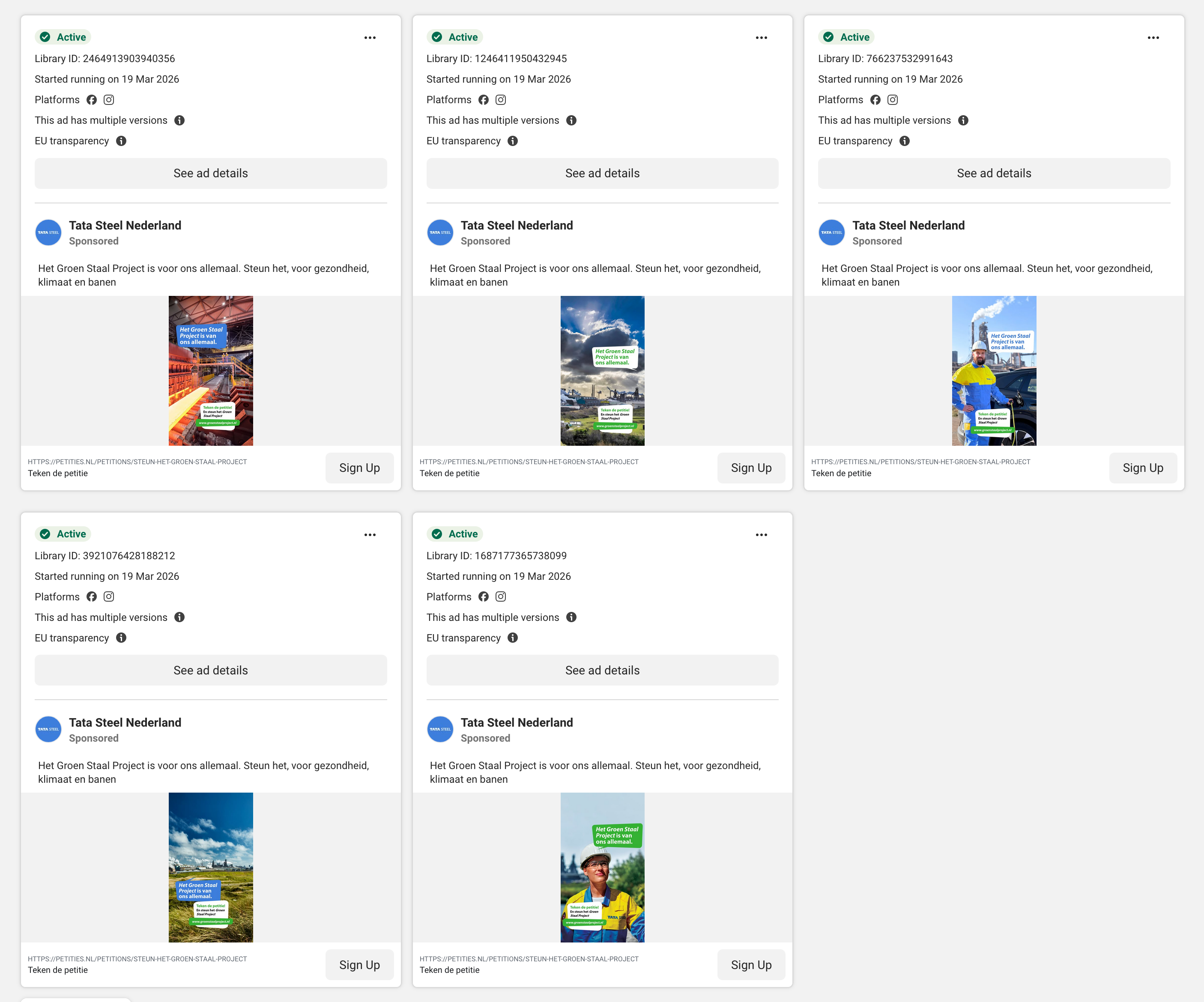
En krantenlezers zijn er nu eenmaal minder dan Facebook en Instagram-gebruikers. Ook is het makkelijker om vanuit een online advertentie te handelen. Je hoeft alleen maar te klikken. Toch voelt het als een vorm van vals spelen. Niet argumenten tellen om aandacht te verdienen maar geld
Vandaag hebben we met 102.211 handtekeningen de petitie Stop de Schuldenindustrie aangeboden in Den Haag
Vandaag hebben we met 102.211 handtekeningen de petitie Stop de Schuldenindustrie aangeboden in Den Haag! Dank je wel dat jij hebt getekend. Dit is geen kleine actie, dit is een beweging.
Kamerleden Jimmy Dijk (SP), Don Ceder (CU), Anouschka Biekman (D66), Esmah Lahlah (GroenLinks-PvdA), André Flach (SGP), Corrie van Brenk (50PLUS), Sarath Hamstra (CDA) en Martin de Beer (VVD) namen de petitie in ontvangst en spraken hun steun uit.
"Organisaties zoals Humanitas zijn nodig, want zij zijn de ruggengraat om te zorgen dat mensen een schuldenvrije toekomst tegemoet gaan." - Don Ceder (CU)
Steun alleen is niet genoeg. Het is tijd voor concrete verandering. Samen met deelnemer Rozemarijn en vrijwilliger Bas hebben we laten zien wat er echt gebeurt: mensen raken niet alleen in de problemen door hun schuld, maar door een systeem dat kosten blijft opstapelen. Dat moet stoppen.
We zetten ons in voor vier simpele, maar krachtige veranderingen:
- Een wettelijke pauzeknop bij schulden
- Recht op duidelijk overzicht van schulden
- Standaard financiële check bij 18 jaar
- Financiële steun voor de inzet van vrijwilligers
Op naar 1000 handtekeningen!
Onze actie loopt uitstekend. Bijna 1000 Badhoevedorpers die ook vinden dat de Schuilhoeve groen mag blijven! Het flyeren, de posters en de nieuwsberichten werpen hun vruchten af. Maar we zijn er nog niet.
We hebben vast nog niet iedereen bereikt. Dus deel deze petitie nog even in je buurtappgroep, je sportteam, je school, etc. Wie weet worden het er nog veel meer!