Nieuws
Petitie overhandigd!
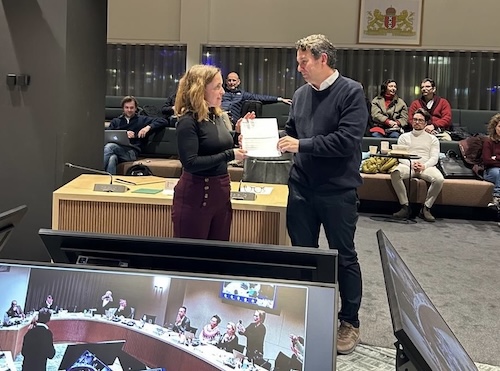
Vanavond heeft de stadsdeelcommissie en -bestuur de petitie ontvangen. Stadsdeelbestuurder Ester Fabriek nam de petitie aan tijdens het inspreken door bewoners met de suggestie op de schermen. De opnames zijn terug te zien via de tijdelijke locatie van de vergaderingen in Nieuw-West.
De Werkgroep Blackspots heeft dit voorstel ook ontvangen. Dit voorstel, samen met hun adviezen, de steun hiervoor van het stadsdeel en het vinden van budget moet de situatie verbeteren.
Met hulp van een tegendenker uit de buurt zijn de onderstaande antwoorden op vragen voorbereid. Die niet allemaal gesteld werden:
Maar de auto's die in het park moeten zijn dan?
Een heel klein stukje verderop het park in, na de portiersloge, is het de norm dat je met alarmlichten aan en 5km/u voorzichtig tussen de voetgangers rijdt. Dat kan heel goed op de brug al beginnen. Laat de auto's vanaf de Haarlemmerweg over een verlaagde stoeprand een voetgangerszone inrijden als ze hier afslaan. Via de andere ingang binnenkomen is beter natuurlijk.
Want nu lijkt het een reguliere afslag, geregeld met verkeerslichten, het is uitnodigend. Dat veroorzaakt ook allerlei autoverkeer. Automobilisten van buiten Amsterdam denken dat je hier met de auto goed kan komen. Terwijl ze er heel ongewenst zijn en ook vaak door de portier weer doorgestuurd worden naar de parkeergarage. Autonavigatie stuurt automobilisten die een bestemming in het park opgeven via deze ingang het park in, alsof ze er helemaal kunnen komen. De portier moet ze dan weer wegsturen naar de parkeergarage bij de Praxis. Als de brug voet- en fietspad wordt hoort daar een verkeersbesluit bij en die worden geautomatiseerd overgenomen door Google, Tomtom en dergelijke. Computer zegt dan wèl nee.
Maar de taxi's die er nu vaak rijden dan?
Van alle mensen die over de brug gaan is het merendeel voetganger of fietser. Duizenden op een dag, dus die moeten dan ook de bijbehorende voorrang krijgen. Behalve tijdens evenementen komen taxi's vooral over de brug om daar buiten een parkeervak te wachten op een oproep, niet om iemand af te zetten of op te halen. En als er incidenteel eens een keer een hotelgast met koffers of een gast voor de tv-studio afgezet moet worden dan kan de taxi gewoon met alarmlichten met 5km/u over de brug. Hotel of televisie-redactie moet maar een instructie toesturen, dat is het nadeel van deze toplocatie. Misschien moet er een taxi-standplaats op de Haarlemmerweg komen, want officieel is de ruimte geen standplaats.
De logische plek voor automobilisten om te stoppen voor het park moet bij het stoplicht op de Haarlemmerweg worden. Dan kunnen passagiers tijdens het wachten voor het rode licht uitstappen.
Komen de hulpdiensten niet in de problemen als autoverkeer niet meer door de Van Limburgstirumstraat mag?
Het is onveilig voor fietsers om zo'n doorgang met paaltjes onmogelijk te maken voor autoverkeer. De Fietsersbond zegt ook altijd paaltjes te mijden, gevaarlijk voor fietsers. Als er geen paaltjes staan kunnen auto's met een blauw zwaailicht op het dak gewoon over dat brede fietspad rijden. Vaak gebeurt het niet omdat het dan gaat om hulpverleners die in of uit deze wijk gaan. De meeste rijden over de Haarlemmerweg. Met een goede inrichting zal autoverkeer dat de Van Limburgstirumstraat inrijdt vanaf het plein linksaf worden geleid, de Joan Melchiorstraat in.
Er is een ingang van een ondergrondse parkeergarage in dat stukje van de Van Limburgstirumstraat, wordt die onbereikbaar?
Die is een stukje de straat in. De auto's voor die parkeergarage laat je over het brede fietspad rijden dat vanaf de garage-ingang pas officieel een fietspad wordt voor het laatste stuk. Ter hoogte van de Joan Melchiorstraat staat er dan al een bord 'doodlopende weg' en 'fietspad over 30 meter" met de suggestie om die straat in te slaan. Het is dan alleen de laatste 15 meter tot aan de Haarlemmerweg een officieel fietspad met rood asfalt en borden erbij enzo. Maar dat is genoeg om het verkeer op de Haarlemmerweg de afslag deze straat in te ontnemen.
Vanaf de Haarlemmerweg is er dan voor automobilisten geen enkele suggestie meer dat ze af kunnen slaan. Nu mogen ze dat al niet trouwens, maar dan zullen ze het nog minder doen dan nu. Het ziet er nu nog wel te uitnodigend uit. De overtreders van verkeersregels doen dat gek genoeg ook altijd op volle snelheid, alsof het dan minder erg is.
Hoe kan je garanderen dat bestuurders niet alsnog in- en uitrijden?
Bij tunnels, bruggen, stegen en dergelijke zijn heel goed mobiele handhavingscamera's te plaatsen. Nu kan dat niet goed op deze plek, maar als elke auto die hier in of uit rijdt voortaan in overtreding is dan is dat een goede plek voor zo'n camera af en toe. Vooral als er kennelijk veel overtredingen zijn en auto's over het fietspad zullen rijden.
Dat is trouwens een behoorlijke overtreding, met een auto over een druk fietspad rijden. Je riskeert een conflict met een fietser en die kan je met je auto nooit snel genoeg achterhalen om je schade te verhalen. Ik betwijfel of veel automobilisten het zullen doen. Ze hebben dan het toekomstige bord 'doodlopende straat over 50m' bij het Van Limburgstirumplein (voor Doardi) gemist. En ook een bord en de weginrichting waarmee ze de Joan Melchiorstraat in worden gestuurd. De weginrichting zegt dan nee. Nu zegt die ja.
Als auto's omrijden, veroorzaakt dat dan niet meer vervuiling?
Een brandstofauto is vervuilend zodra die gaat rijden. Op de gemiddelde afstand van een autoritje is dit stukje extra minimaal, vergelijkbaar met de motor stationair laten draaien om op je telefoon te klooien. De meeste automobilisten zullen hun routines en routes aanpassen. De enige automobilisten die iets meer zullen rijden wonen ten noorden van het Van Limburgstirumplein. De rest rijdt ofwel evenwijdig aan de Haarlemmerweg naar de Van Hallstraat (stad uit) ofwel enkele tientallen meters om via de Van der Hoop en Van der Duijnstraat (centrum in). Maar juist de omwonenden die niet meer makkelijk de Haarlemmerweg in kunnen draaien hebben ook het meeste profijt van deze ingreep als ze niet in de auto rijden.
Als auto's omrijden, wordt de kans op ongelukken dan niet groter?
De twee andere kruisingen met de Haarlemmerweg zijn veiliger. Die met de Van Hallstraat is recent verbeterd. Die met de Van Der Duijnstraat heeft de status van een uitrit en moet al het verkeer voorrang geven totdat er niets meer aankomt. Ook is die niet zo onoverzichtelijk als de kruising met de Van Limburgstirumstraat nu, waar de grote stromen voetgangers en fietsers doorheen gaan.
Mensen klagen nu al over een onbereikbare buurt, hoe zorg je dat de wijk bereikbaar blijft voor bewoners?
Dan bedoelen ze vast bereikbaar voor automobilisten. De buurt is en blijft heel goed bereikbaar voor mensen. Nu al heeft de Van Limburgstirumstraat eenrichtingsverkeer vanaf de Haarlemmerweg. Dus de wijk in verandert er niets voor automobilisten. Wel wordt het duidelijker. De wijk uit wordt het omrijden naar de Van Hall. Richting centrum de Van der Duijnstraat. De gemeente kan een telling houden om hoeveel auto's het gaat en of de infrastructuur het aan kan.
In ruil daarvoor wordt deze plek veel rustiger en veiliger, want vooral 's avonds en 's nachts wordt er af en toe snel gereden omdat de asfaltweg daartoe uitnodigt. Een Van der Duijnstraat zal dat veel minder doen. Die is alleen te vinden met navigatie, het meeste verkeer zal via de Van Hall gaan.
Eigenlijk is het gek dat zowel de Van Limburgstirumstraat als de Van der Duijnstraat auto's op de Haarlemmerweg laten uitkomen. Tussen beide straten zit maar 100 meter.
Waarom kunnen we niet gewoon drempels plaatsen? Wat maakt de Haarlemmerweg veiliger als we de Limburg van Stirumstraat afsluiten? De ongelukken gebeuren op de Haarlemmerweg: mensen die van het park naar de Stirumstraat fietsen.
De onduidelijke situatie op deze kruising is de kern van het probleem. Als auto's geen optie meer hebben om af te slaan en alleen stoppen om fietsers en voetgangers over te laten steken wordt het veel overzichtelijker voor iedereen. Auto's stoppen om fietsers en voetgangers over te laten steken die allemaal tegelijk oversteken van links en rechts. Als de fietsers en voetgangers rood hebben (op de brug en vanuit de Van Limburgstirumstraat) hebben de automobilisten op de Haarlemmerweg groen. En andersom.
Referendum over het Amsterdamse erfpachtstelsel is een stuk dichterbij gekomen
Bijna 6.750 Amsterdamse woningbezitters spraken zich uit voor een dergelijke volksraadpleging, mede dankzij een e-mail van Vereniging Eigen Huis aan 22.000 leden in de hoofdstad. Volgens Steven Wayenberg, juridisch beleidsmedewerker bij Vereniging Eigen Huis, is massaal gereageerd op de e-mail.
'Door het tekenen van petitie van de erfpachterstichting SEBA is een referendum over het Amsterdamse erfpachtstelsel een stuk dichterbij gekomen', zegt Wagenberg.
President Bulgarije roept op tot nieuwe verkiezingen
De president brengt hier zijn stem uit bij de verkiezingen in mei De Bulgaarse president Rosen Plevneliev heeft vrijdag opgeroepen tot nieuwe parlementsverkiezingen. Volgens hem is dit de enige weg uit de politieke chaos die het land al het hele jaar lamlegt. Bulgaarse kiezers zijn amper bekomen van de vorige verkiezingen, die op 2 mei zijn gehouden.
De regering was toen opgestapt na hevige protesten tegen de gestegen energieprijzen. Nu zijn ontevreden Bulgaren opnieuw massaal de straat opgegaan. De protesten begonnen nadat de nieuwe regering, een minderheidscoalitie van socialisten en liberalen, een omstreden mediamagnaat benoemde als hoofd van de veiligheidsdienst. Die benoeming is inmiddels teruggedraaid, maar de demonstranten zijn niet tevreden. Steeds luider eisen zij het vertrek van de coalitie. Premier Oresharski heeft herhaaldelijk gezegd dat hij niet aftreedt, maar nu ook de president pleit voor vervroegde verkiezingen, lijkt de val van het kabinet een kwestie van tijd.
Demonstraties duren al 26 dagen in Bulgarije
De demonstraties zijn doorgegaan voor de 26e achtereenvolgende dag in de hoofdstad Sofia;waarbij het doel nog steeds is dat de regering aftreedt. Critici beschuldigen de socialistische premier Plamen Oresharski van corruptie en een gebrekaan transparantie. .
Impressie van manifestatie op Het Plein in Den Haag 4 juli 2013
Impressie Manifestatie van 4 juli op het Plein voor de Tweede Kamer. Er zijn verschillende Kamerleden naar ons toe gekomen, die veel aandacht hadden voor de problemen in de jeugdzorg. Hierbij waren o.a.
Henk Krol (50Plus), Vera Bergkamp (D66), Mona Keijzer (CDA), Harry van Bommel (SP) Hoewel aan aanwezige ouders beloften waren gedaan door Nine Kooiman (SP) en Loeps Ypma (PvdA) om ons te bezoeken, blaakten deze door afwezigheid. Jammer en een teleurstelling voor de ouders die op hun rekenden. Dit werd echter ruimschoots goedgemaakt door de duidelijke interesse van de Kamerleden die wel kwamen en zoveel tijd voor ons namen. Daarom mijn speciale dank voor Vera Bergkamp, Mona Keyzer, Henk Krol en Harry Bommel. Bovendien hebben we de toezegging dat er na het reces verdere gesprekken met ons zullen zijn. ik dacht dat we hierin vooral weer duidelijk over waarheidsvinding en sancties tegen opzettelijk verkondigen van onwaarheden moeten aankaarten. Een ander erg onder belicht punt is de rol van grootouders na een uhp en ook gisteren bleek dat de Kamerleden hiervan niet goed op de hoogte zijn en dat we dit punt het verdient om extra onder de aandacht te worden gebracht. Mocht u zelf nog andere punten op de agenda willen zetten, kunt u ze hier vermelden. Wij zullen dan t.z.t een agenda opstellen en de gisteren aanwezige ouders uitnodigen voor een gesprek. voor beelden zie: http://www.youtube.com/watch?v=b44Z8IQ04dM http://petities.nl/nieuws/petities-manifestatie-op-4-juli-geslaagd http://www.hyves.nl/externalRedirect/?url=http%3A%2F%2Fwww.flickr.com%2F%2Fphotos%2F98442846%40N05%2Fsets%2F72157634489554111%2Fshow%2F
24e dag protesten in Sofia, Bulgarije
Bulgaarse protesten in Sofia houden aan Demonstranten hebben zich verzameld in de Bulgaarse hoofdstad voor de 24e achtereenvolgende dag. Ze uiten hun ongenoegen ten aanzien van Premier Plamen Oresharski en zijn benoemingvan de controversiële mediamagnaat Delyan Peevski als Voorzitter van 'State Agency for National Security' (?.?.?.?). Ondanks het feit dat Peevski afziet van zijn benoeming, vragen de demonstranten omhet aftreden van de regering en om veranderingen in het electorale systeem om het Bulgaarse volk beter te representeren in het parlement. .
25 jaar na omwenteling nog geen democratie
Who are the Bulgarian protesters? 06/07 08:53 CET According to the CIAs official statistics, Bulgarias death rate is the eighth highest in the world. Afghanistan, war-torn for decades, is seventh.
Somalia is ninth. A handful of countries before Bulgaria have gone through sustained armed conflict, famine, genocide, apartheid and a nuclear disaster. And Bulgarians? Bulgarians went through 23 years of democratic transition. The above fact hints at a key reason for the protests that have marked 2013 and are still drawing thousands of people to anti-government protests day after day: ever since the democratic changes of 1989, life in Bulgaria has been unduly hard. The protesters presently crowding the plaza surrounding the Bulgarian National Assembly and demanding the Cabinets resignation, belong to the generation which was in primary school circa 1989. They belong to the generation which grew up in a deprived society of clashing values and persistent uncertainty. But crucially, they also belong to the generation which, for the first time in Bulgarian modern history, could read world news, travel widely and compare. The contrast they found between their reality and the rest of European civilization was devastating. It still is today and the protesters are tired of living in limbo. The thirty-somethings of Bulgaria had been silent till now too busy trying to sort out their careers and families in an ever-contracting economy and an environment of growing lawlessness and nepotism. Sometimes, too busy planning emigration. This is their first mass outing, their first show of concerted citizen will an organized discontent, growing out of several green movements which gained traction in the countrysince the mid-00s precisely because they offered a politically unaffiliated i.e. unsullied outlet for the frustrations Bulgarians had with a long line of resource-stripping, land-grabbing, neglectful and polluting governments. The people protesting in front of the Parliament today feel cheated out of their youth, dreams and hopes: after nearly a quarter century of change, nothing in their lives has actually changed for good. Their formative years were spent in conditions of deepening nihilism between 1994 and 2012 dabbling in Bulgarian politics morphed from a challenging, ideal-bound job into a bona fide criminal career. Ministries became the front-facing shops of the proliferating mafia structures, manned by ousted, but well-connected Communist functionaries, and hundreds of disaffected secret police agents and prospectless young wrestlers and boxers, let down by the sudden loss of state subsidy for their local clubs (such were established in most towns in Communist times). As children and teens, the current protest generation had to endure the doomed attempts of a nascent political scene to generate elites untainted by Communist ties a near impossibility in a society where access to power was so tightly controlled that there was virtually no other way in. Having actual political experience equaled a compromised background. To illustrate: as of this year, more than half of the currently serving Bulgarian diplomats are still persons with proven links to the oppressive apparatus of the former Communist state security services. The latest protests were triggered by the same legacy of entrenched, deeply illegitimate power: the snap elections on May 11 produced the current stillborn coalition between the Bulgarian Socialist Party (heir to the seemingly dismantled all-powerful Communist Party) and ethnic Turkish party Movement for Rights and Freedoms, with Plamen Oresharski as Prime Minister. In its first days in power, the new government, aided by a largely unchanged Parliament, attempted to shoo in Delyan Peevski (a widely reviled protégé of massive criminal monopolies, under multiple investigations himself) as head of DANS an ill-conceived, yet highly powerful national security structure tasked with investigating organized crime activity. This paradox was seen as a monstrous gesture of contempt towards the Bulgarian people: it is one thing to tacitly advance the toxic meshing of democratic institutions and organized crime structures. It is quite another to rub it in the face of a nation that just ousted another primitive and abusive government. When todays protesters were growing up, they witnessed the progressive deterioration of vital institutions, the arbitrary change of governments, but not of attitudes and political practices each Cabinet appeared more absurd, incompetent and unprincipled than the last. The currency crashed, the shops had no food. The abrupt change from command economy to free market capitalism plunged vast swathes of the population into sudden, shocking poverty, accompanied by loss of dignity, status and security. Stunned, disoriented and angry, Bulgarians went to the ballot in ever dwindling numbers, mostly to avenge themselves against the latest government that overpromised and underdelivered. Elections became the public executions of politicians and parties, and, finally, of the concept of government itself. This is how beginning with 2000, Bulgarians voted in a progression of ever odder political entities from one-man parties such as the National Movement Simeon II (which produced the paradox of installing deposed prince Simeon Saxe-Coburg-Gotha as a republican Prime Minister without formally rescinding his royal claims) and GERB (the charismatic movement around strongman Boyko Borisov, ousted by protests in February this year), to ultranationalist scandal-mongers Ataka, busy inciting ethnic hatred against the significant minority of Bulgarian Turks. It continued thus until no party, no politician was able to claim an ounce of decency or respect. This mutual schism in Bulgarian public consciousness, pitting everybody who was in politics against everybody who was not, helped Bulgarian society arrive where it stands today. Party lines, for purposes other than public debates and election campaigns, are blurred beyond recognition. Trust in institutions is practically nil. Voters struggle to identify a true, meaningful alternative in terms of viable political opposition. Bulgarians either avoid voting altogether, disgusted with the mere thought of enabling the same revolving set of failed politicians, or go to the ballot not with their future in mind, but to punish, to lash out, to tear down. Everything that seemed new and untried before appeared preferable to whatever current government was in charge, so no Cabinet was actually allowed space and time to see though meaningful reforms. In turn, each successive Cabinet busied itself predominantly with undoing what the previous ones had done and reallocating resources to insiders a party mandate didnt mean governing a country, but simply draining it for personal gain and exploiting it as a vast sweatshop. To quote a recent Reuters publication: Were effectively dealing with a Wild West country, said an EU official who handles east Europe, voicing doubts about Bulgarias ability to enforce the law and live by democratic norms. This stinging judgment echoes ominously for the future of Bulgarian statehood it indicates that the country has exhausted its credit of post-Cold War good will in the eyes of its aspirational model Western Europe. While in the 90s the West may have been willing to help Bulgaria along, now the country is viewed more as a grand nuisance, a baffling liability in the periphery of the European Union. The demonstrators standing vigil in the cold nights of November 1989, shouting Times are changing! Its our time! felt the world was watching. The free world was behind them, the Iron Curtain was melting, help was on its way. It was an illusion, ultimately, but it sustained them. Today, the children of those same protesters doggedly demand the resignation of another morally bankrupt government the last, ugly spawn of a transition whose course was fatally perverted from the very start. They stand in the sweltering July evenings on the same yellow-bricked plaza, in front of the same Parliament building. They know now times have not changed. They know they stand alone. Maria Spirova Maria Spirova is an award-winning Bulgarian journalist with over 10 years of agency and long-form experience. Copyright © 2013 euronews
verloop 22e dag protesten Bulgarije
Bulgarians Break into Applauses for President on 22nd Day of Anti-Govt Protests July 5, 2013, Friday| Send to Kindle Over the previous days the rallies against Bulgaria's Socialist-endorsed government of Plamen Oresharski proved to be one of the largest ones held in the capital Sofia in the last 15 years. Photo by BGNES For the twenty-second day in a row, thousands of protesters have taken to the streets in Sofia, calling for the resignation of Bulgaria's socialist-led government and praising calls for early elections. Over the previous days the rallies against Bulgaria's Socialist-endorsed government of Plamen Oresharski proved to be one of the largest ones held in the capital Sofia in the last 15 years. On Friday evening, the crowd stopped in front of the presidency and broke into applauses.
That was a reaction to the presidents call for early elections, which he made clear in an address to the nation earlier on Friday. Earlier in the day Bulgarias president called for new early elections, claiming this is the only way out of the ongoing political crisis and mass protests. Early parliamentary elections are the only democratic solution to the crisis we are in. To tell people that new early elections are a dangerous scenario is to tell them that democracy is dangerous, Rosen Plevneliev said in his address to the nation in connection with the tense situation in the country. Bulgarians are protesting peacefully, which is a clear sign our society is mature . What is most worrying is that there were attempts to artificially provoke ethnic conflicts. This means playing with fire and the consequences could be disastrous. Havent we learned anything from our neighbors? I firmly condemn those provocations!The series of anti-government protests in Bulgaria was triggered by the scandalous appointment of controversial media mogul Delyan Peevski as Chair of the State Agency for National Security (DANS).Although the appointment was revoked, the people went on to demand that the cabinet resign collectively over ties with oligarchs.Protesters are also calling for Election Code amendments which will guarantee greater representation of the people in Parliament.Plevneliev has backed the protests earlier, but two days ago he said the solution for the crisis was not a "revolution, but right steps in the right direction."According to him, the political instability has a negative influence on entrepreneurs and investments. He stressed the crisis in the country is not an economic one as the macroeconomic indicators are stable, due to the strict fiscal policy and the established fundamental "culture of stability on the backdrop of the currency board."The President believes the political parties need counter-pressure, but with concrete and well-postulated demands.Bulgarias embattled Socialist-backed government however has repeatedly denied rampant speculations that it is considering resignation amid mass protests.The issue is not on our agenda at all. We have never discussed it," Defense Minister Anguel Naydenov told bTV on Sunday morning.We have strong support from people in the whole country. So there is no cause to be disturbed by the fact that several thousand protesters are demanding our resignation. We have no intention to resign now or in May. We have lots to offer in terms of social and other measures, Naydenov pointed out.The statement came days after Prime Minister Plamen Oresharski made it clear he will not resign as long as the government has the support of Bulgarias parliament.He denied hinting at quitting his post when the opposition boycotted the parliamentary sitting and it was cancelled.This is your own interpretation of my words, he told reporters.This is the second time that the embattled prime minister defies calls to resign.Earlier in the month he warned that the renewed political crisis might jeopardise Bulgaria's negotiations for EU aid between 2014 and 2020 and cost the newcomer billions of euros in lost subsidies.Quitting now would also mean a deepening of the economic and social crisis, he said.The prospect of new early elections loomed large in Bulgaria on Wednesday after the Socialist Party also said it is bracing up for snap polls amid fears the opposition will continue to hamper the work of parliament.The Socialists feared that the leader of the nationalists party Ataka Volen Siderov and his MPs will continue to boycott the parliament and the plenary sitting will have to be cancelled.Members of the center-right party Citizens for European Development of Bulgaria, GERB, are also boycotting the parliamentary sittings, saying they will attend only if changes to the Election Code are on the agenda.Meanwhile Bulgaria's former Interior Minister Tsvetan Tsvetanov stated that early general elections in September would be the best scenario for the country.
Nederlandse Vereniging van Erfpachters ondersteunt referendum erfpacht Amsterdam
Amsterdam is bezig met het moderniseren van het erfpachtstelsel. Dit omdat het systeem onduidelijk en niet transparant is.
De inspanningen van NLVE en SEBA in de afgelopen jaren hebben de gemeente hier mede toe aangezet. Wat wij al vreesden blijkt nu ook bewaarheid te worden. Van Poelgeest wil bij de verkoop van een woning alle waardestijging afromen door de koper van uw woning een hogere canon in rekening te brengen. Dit betekent dat de prijsstijging van uw huis door inflatie, marktvraag en uw investeringen in de verbetering van uw woning bij verkoop overgeheveld worden naar de gemeente. HELP UZELF/ONS EN TEKEN DEZE PETITIE, STUUR DE LINK DOOR NAAR ZOVEEL MOGELIJK BEKENDEN IN AMSTERDAM.
Nederlandse Vereniging van Erfpachters site