Updates
Petitie overhandigd!
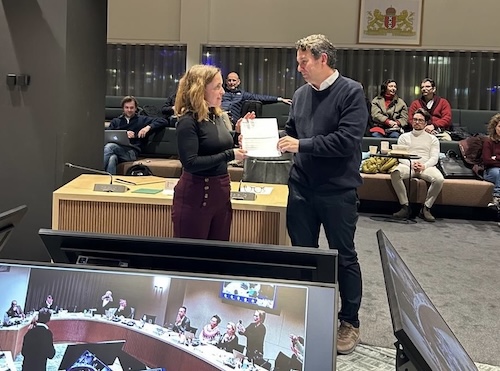
Vanavond heeft de stadsdeelcommissie en -bestuur de petitie ontvangen. Stadsdeelbestuurder Ester Fabriek nam de petitie aan tijdens het inspreken door bewoners met de suggestie op de schermen. De opnames zijn terug te zien via de tijdelijke locatie van de vergaderingen in Nieuw-West.
De Werkgroep Blackspots heeft dit voorstel ook ontvangen. Dit voorstel, samen met hun adviezen, de steun hiervoor van het stadsdeel en het vinden van budget moet de situatie verbeteren.
Met hulp van een tegendenker uit de buurt zijn de onderstaande antwoorden op vragen voorbereid. Die niet allemaal gesteld werden:
Maar de auto's die in het park moeten zijn dan?
Een heel klein stukje verderop het park in, na de portiersloge, is het de norm dat je met alarmlichten aan en 5km/u voorzichtig tussen de voetgangers rijdt. Dat kan heel goed op de brug al beginnen. Laat de auto's vanaf de Haarlemmerweg over een verlaagde stoeprand een voetgangerszone inrijden als ze hier afslaan. Via de andere ingang binnenkomen is beter natuurlijk.
Want nu lijkt het een reguliere afslag, geregeld met verkeerslichten, het is uitnodigend. Dat veroorzaakt ook allerlei autoverkeer. Automobilisten van buiten Amsterdam denken dat je hier met de auto goed kan komen. Terwijl ze er heel ongewenst zijn en ook vaak door de portier weer doorgestuurd worden naar de parkeergarage. Autonavigatie stuurt automobilisten die een bestemming in het park opgeven via deze ingang het park in, alsof ze er helemaal kunnen komen. De portier moet ze dan weer wegsturen naar de parkeergarage bij de Praxis. Als de brug voet- en fietspad wordt hoort daar een verkeersbesluit bij en die worden geautomatiseerd overgenomen door Google, Tomtom en dergelijke. Computer zegt dan wèl nee.
Maar de taxi's die er nu vaak rijden dan?
Van alle mensen die over de brug gaan is het merendeel voetganger of fietser. Duizenden op een dag, dus die moeten dan ook de bijbehorende voorrang krijgen. Behalve tijdens evenementen komen taxi's vooral over de brug om daar buiten een parkeervak te wachten op een oproep, niet om iemand af te zetten of op te halen. En als er incidenteel eens een keer een hotelgast met koffers of een gast voor de tv-studio afgezet moet worden dan kan de taxi gewoon met alarmlichten met 5km/u over de brug. Hotel of televisie-redactie moet maar een instructie toesturen, dat is het nadeel van deze toplocatie. Misschien moet er een taxi-standplaats op de Haarlemmerweg komen, want officieel is de ruimte geen standplaats.
De logische plek voor automobilisten om te stoppen voor het park moet bij het stoplicht op de Haarlemmerweg worden. Dan kunnen passagiers tijdens het wachten voor het rode licht uitstappen.
Komen de hulpdiensten niet in de problemen als autoverkeer niet meer door de Van Limburgstirumstraat mag?
Het is onveilig voor fietsers om zo'n doorgang met paaltjes onmogelijk te maken voor autoverkeer. De Fietsersbond zegt ook altijd paaltjes te mijden, gevaarlijk voor fietsers. Als er geen paaltjes staan kunnen auto's met een blauw zwaailicht op het dak gewoon over dat brede fietspad rijden. Vaak gebeurt het niet omdat het dan gaat om hulpverleners die in of uit deze wijk gaan. De meeste rijden over de Haarlemmerweg. Met een goede inrichting zal autoverkeer dat de Van Limburgstirumstraat inrijdt vanaf het plein linksaf worden geleid, de Joan Melchiorstraat in.
Er is een ingang van een ondergrondse parkeergarage in dat stukje van de Van Limburgstirumstraat, wordt die onbereikbaar?
Die is een stukje de straat in. De auto's voor die parkeergarage laat je over het brede fietspad rijden dat vanaf de garage-ingang pas officieel een fietspad wordt voor het laatste stuk. Ter hoogte van de Joan Melchiorstraat staat er dan al een bord 'doodlopende weg' en 'fietspad over 30 meter" met de suggestie om die straat in te slaan. Het is dan alleen de laatste 15 meter tot aan de Haarlemmerweg een officieel fietspad met rood asfalt en borden erbij enzo. Maar dat is genoeg om het verkeer op de Haarlemmerweg de afslag deze straat in te ontnemen.
Vanaf de Haarlemmerweg is er dan voor automobilisten geen enkele suggestie meer dat ze af kunnen slaan. Nu mogen ze dat al niet trouwens, maar dan zullen ze het nog minder doen dan nu. Het ziet er nu nog wel te uitnodigend uit. De overtreders van verkeersregels doen dat gek genoeg ook altijd op volle snelheid, alsof het dan minder erg is.
Hoe kan je garanderen dat bestuurders niet alsnog in- en uitrijden?
Bij tunnels, bruggen, stegen en dergelijke zijn heel goed mobiele handhavingscamera's te plaatsen. Nu kan dat niet goed op deze plek, maar als elke auto die hier in of uit rijdt voortaan in overtreding is dan is dat een goede plek voor zo'n camera af en toe. Vooral als er kennelijk veel overtredingen zijn en auto's over het fietspad zullen rijden.
Dat is trouwens een behoorlijke overtreding, met een auto over een druk fietspad rijden. Je riskeert een conflict met een fietser en die kan je met je auto nooit snel genoeg achterhalen om je schade te verhalen. Ik betwijfel of veel automobilisten het zullen doen. Ze hebben dan het toekomstige bord 'doodlopende straat over 50m' bij het Van Limburgstirumplein (voor Doardi) gemist. En ook een bord en de weginrichting waarmee ze de Joan Melchiorstraat in worden gestuurd. De weginrichting zegt dan nee. Nu zegt die ja.
Als auto's omrijden, veroorzaakt dat dan niet meer vervuiling?
Een brandstofauto is vervuilend zodra die gaat rijden. Op de gemiddelde afstand van een autoritje is dit stukje extra minimaal, vergelijkbaar met de motor stationair laten draaien om op je telefoon te klooien. De meeste automobilisten zullen hun routines en routes aanpassen. De enige automobilisten die iets meer zullen rijden wonen ten noorden van het Van Limburgstirumplein. De rest rijdt ofwel evenwijdig aan de Haarlemmerweg naar de Van Hallstraat (stad uit) ofwel enkele tientallen meters om via de Van der Hoop en Van der Duijnstraat (centrum in). Maar juist de omwonenden die niet meer makkelijk de Haarlemmerweg in kunnen draaien hebben ook het meeste profijt van deze ingreep als ze niet in de auto rijden.
Als auto's omrijden, wordt de kans op ongelukken dan niet groter?
De twee andere kruisingen met de Haarlemmerweg zijn veiliger. Die met de Van Hallstraat is recent verbeterd. Die met de Van Der Duijnstraat heeft de status van een uitrit en moet al het verkeer voorrang geven totdat er niets meer aankomt. Ook is die niet zo onoverzichtelijk als de kruising met de Van Limburgstirumstraat nu, waar de grote stromen voetgangers en fietsers doorheen gaan.
Mensen klagen nu al over een onbereikbare buurt, hoe zorg je dat de wijk bereikbaar blijft voor bewoners?
Dan bedoelen ze vast bereikbaar voor automobilisten. De buurt is en blijft heel goed bereikbaar voor mensen. Nu al heeft de Van Limburgstirumstraat eenrichtingsverkeer vanaf de Haarlemmerweg. Dus de wijk in verandert er niets voor automobilisten. Wel wordt het duidelijker. De wijk uit wordt het omrijden naar de Van Hall. Richting centrum de Van der Duijnstraat. De gemeente kan een telling houden om hoeveel auto's het gaat en of de infrastructuur het aan kan.
In ruil daarvoor wordt deze plek veel rustiger en veiliger, want vooral 's avonds en 's nachts wordt er af en toe snel gereden omdat de asfaltweg daartoe uitnodigt. Een Van der Duijnstraat zal dat veel minder doen. Die is alleen te vinden met navigatie, het meeste verkeer zal via de Van Hall gaan.
Eigenlijk is het gek dat zowel de Van Limburgstirumstraat als de Van der Duijnstraat auto's op de Haarlemmerweg laten uitkomen. Tussen beide straten zit maar 100 meter.
Waarom kunnen we niet gewoon drempels plaatsen? Wat maakt de Haarlemmerweg veiliger als we de Limburg van Stirumstraat afsluiten? De ongelukken gebeuren op de Haarlemmerweg: mensen die van het park naar de Stirumstraat fietsen.
De onduidelijke situatie op deze kruising is de kern van het probleem. Als auto's geen optie meer hebben om af te slaan en alleen stoppen om fietsers en voetgangers over te laten steken wordt het veel overzichtelijker voor iedereen. Auto's stoppen om fietsers en voetgangers over te laten steken die allemaal tegelijk oversteken van links en rechts. Als de fietsers en voetgangers rood hebben (op de brug en vanuit de Van Limburgstirumstraat) hebben de automobilisten op de Haarlemmerweg groen. En andersom.
Het Parool, Theodor Holman: 'Een boekwinkel is als een gigantisch hoofd'
'Boekwinkels behoren tot de niet-essentiële winkels. Dus zijn ze gesloten tijdens de lockdown.
Je kunt niet beweren dat ze dicht moeten blijven omdat er anders te veel reisbewegingen of boekenliefhebbersbewegingen zijn. In een boekhandel komen minder mensen dan in een supermarkt.
Mij verbaast de vanzelfsprekendheid bij een hoger echelon dat zegt dat boekwinkels niet essentieel zijn. De redenering om ze gesloten te houden (...)' lees verder
Uitgebreide rectificatie in Volkskrant
Tot mijn blijdschap reageerde de redactie direct en boetvaardig.
Hier het nieuwe artikel:
https://www.volkskrant.nl/nieuws-achtergrond/tu-delft-maakt-eurocommissaris-timmermans-eredoctor-en-alumni-protesteren-met-een-petitie~b5fcd6b7/.
De echte reden waarom Nixon de war on drugs is begonnen:
https://amp.cnn.com/cnn/2016/03/23/politics/john-ehrlichman-richard-nixon-drug-war-blacks-hippie/index.html
BRON: LoBianco, 2016
Washington(CNN) One of Richard Nixon's top advisers and a key figure in the Watergate scandal said the war on drugs was created as a political tool to fight blacks and hippies, according to a 22-year-old interview recently published in Harper's Magazine.
"The Nixon campaign in 1968, and the Nixon White House after that, had two enemies: the antiwar left and black people," former Nixon domestic policy chief John Ehrlichman told Harper's writer Dan Baum for the April cover story published Tuesday.
"You understand what I'm saying? We knew we couldn't make it illegal to be either against the war or black, but by getting the public to associate the hippies with marijuana and blacks with heroin. And then criminalizing both heavily, we could disrupt those communities," Ehrlichman said.
"We could arrest their leaders. raid their homes, break up their meetings, and vilify them night after night on the evening news. Did we know we were lying about the drugs? Of course we did."
Ehrlichman's comment is the first time the war on drugs has been plainly characterized as a political assault designed to help Nixon win, and keep, the White House.
It's a stark departure from Nixon's public explanation for his first piece of legislation in the war on drugs, delivered in message to Congress in July 1969, which framed it as a response to an increase in heroin addiction and the rising use of marijuana and hallucinogens by students.
However, Nixon's political focus on white voters, the "Silent Majority," is well-known. And Nixon's derision for minorities in private is well-known from his White House recordings.
The comments come as there has been a marked shift in attitudes toward handling drug use -- ranging from the legalization of marijuana in various states to White House candidates focusing heavily on treatment as an answer to New Hampshire's heroin epidemic while they were campaigning across the state.
RELATED: 2016 candidates on the front lines of N.H. drug epidemic
Ehrlichman died in 1999, but his five children in questioned the veracity of the account.
"We never saw or heard anything from our dad, John Ehrlichman, that was derogatory about any person of color," wrote Peter Ehrlichman, Tom Ehrlichman, Jan Ehrlichman, Michael Ehrlichman and Jody E. Pineda in a statement provided to CNN.
"The 1994 alleged 'quote' we saw repeated in social media for the first time today does not square with what we know of our father. And collectively, that spans over 185 years of time with him," the Ehrlichman family wrote. "We do not subscribe to the alleged racist point of view that this writer now implies 22 years following the so-called interview of John and 16 years following our father's death, when dad can no longer respond. None of us have raised our kids that way, and that's because we were not raised that way."
Ehrlichman's comments did not surface until now after Baum remembered them while going back through old notes for the Harper's story. Baum said he had no reason to believe Ehrlichman was being dishonest and viewed them as "atonement" from a man long after his tumultuous run in the White House ended.
"I think Ehrlichman was waiting for someone to come and ask him. I think he felt bad about it. I think he had a lot to feel bad about, same with Egil Krogh, who was another Watergate guy." Baum told CNN.
Baum interviewed Ehrlichman and others for his 1996 book "Smoke and Mirrors," but said he left out the Ehrlichman comment from the book because it did not fit the narrative style focused on putting the readers in the middle of the backroom discussions themselves, without input from the author.
Baum equated Ehrlichman's admission with traumatic war stories that often take decades for veterans to talk about and said it clearly took time for Ehrlichman and other Nixon aides he interviewed to candidly explain the war on drugs.
"These guys, they knew they'd done bad things and they were glad finally when it was no longer going to cost them anything to be able to talk about it, to atone for it." Baum said. "Nobody goes in to public service, I don't think, on either side of the political aisle, to be repressive, to be evil. They go in because they care about the country."
Artikel in de Volkskrant
Ha! een artikel in de volkskrant!
Dit schreef ik de redactie:
Geachte redactie,
Blij met de aandacht voor mijn petitie. Die sloeg om in wanhoop bij het lezen van deze zinsneden:
"Asselbergs en zijn medestanders kritiseren Timmermans’ positieve opvattingen over onder meer kernenergie. Hij zou daarmee de transitie alleen maar in de weg staan.
“
Dit is een dusdanige omkering van wat in de openingen van mijn petitie staat, dat van een typefout geen sprake kan zijn.
Ik beschouw het maar als kwade wil.
Hoogachtend,
Jan Asselbergs
Nieuws
allereerst de beste wensen! We hebben van het weekend een begeleidende brief geschreven om de petitie aan te bieden aan de toekomstige minister van VWS dhr E. Kuipers.
We hopen op een positief resultaat.
Honory Doctorate for Frans Timmermans
TU Delft wants to award Frans Timmermans an honorary doctorate for his alleged contributions to energy transition policy. However, Frans Timmermans is a champion of biomass plants and he claims that nuclear power is too expensive and that the construction of a plant takes 20 years.
This, and the message that Delft University publicly announced that doubt is excluded from climate discussions brought me to start a petition.
It would be nice if alumni include their titles. An anonymous vote has some value, but anonymity often is not necessary..
For our foreign friends
Open New Year message to the Rector of the Delft University of Technology (TU Delft) The Hague, January 1, 2022
Dear colleague van der Hagen,
In the capacity as former MSc student, former PhD student, former professor, former member of the Executive Board of the TU Delft – and also as an active member of the KNAW – I address you on the following at the first day of the new year.
Scientific organizations serve society by fostering, creating and passing on new scientific knowledge through research and teaching.
Today, quality universities have become a primary source of prosperity in the area where they are located. The higher the scientific level realized, the greater the contribution to prosperity.
Universities, therefore, should promote excellence at all times. This means that they should not settle for followership, but aim for leadership in their scientific fields. It also means that universities are communities without ideological and political purposes. And above all, at universities the principle of Freedom of Speech and Inquiry are by no means negotiable. History shows that new insights come from doubters and dissenters; they ensure scientific progress. Those scientific 'rebels' must therefore be given every freedom to question what already exists and to present new concepts, with the aim of getting closer to the truth. Universities should nurture these creative scientists. After all, consensus in science means the end of progress.
How different it is in politics. Politics is not about truth, but about power. In the most favorable situation, power is obtained democratically. Whoever manages to gather the most votes comes to power. We know that political rebels end up badly. So, searching for the truth has nothing to do with what the political majority wants. Every university should therefore keep far away from politics.
In short, truth-seeking (argumentum ad verecundiam) and power-seeking (argumentum ad populum) do not fit together at all. Even worse, they obstruct each other. The conclusion is therefore that University Boards should not ‘play little parliament’ in their boardrooms.
The foregoing brings me to the honorary doctorate you are going to confer on Frans Timmermans. This politician has done just about everything in his career to abuse science. He did so by intertwining searching for the truth with political majority building. That has led to the glorification of a climate theory that does not correspond to what we observe in nature, meaning it is scientifically wrong. And this wrong science has resulted into the introduction of a climate policy that has plunged Europe into an energy crisis. And that energy crisis means that Europe has been thrown into a negative socio-economic spiral. Colleague van der Hagen, with all respect, which technical or economic or social merits of Timmermans do you have in mind?
I invite you to watch and listen to this historic interview with Frans Timmermans:
https://www.youtube.com/watch?v=xgEcIQ_WoiU
It was already clear even at that time that Timmermans intended to abuse science for his own political gain. The last ten years have only confirmed that. TU Delft, as a so-called 'climate university', went along with this. Now, you award an honorary doctorate to this person?
Finally, I repeat, Frans Timmermans, with his climate policy, has plunged Europe into an energy crisis with major socio-economic consequences. Please, look at the facts! I therefore urge you nót to award this man with an honorary doctorate. TU Delft will go down in history as the technological university that - under your leadership - scientifically supported the destructive climate policy of this politician and then even awarding him with an honorary doctorate.
Colleague van der Hagen, start the new year well and show courage by retracing your steps. Please, do nót confer an honorary doctorate on this politician.
With collegial regards, Guus Berkhout MSc student from 1952 -1957 Ph.D. Cum laude in 1971 Professor 1976 - 2016 Member of the Delft University Board from 1997 - 2001 Member of the Royal Netherlands Academy of Arts and Sciences since 1990
Applaus
https://www.voordewereldvanmorgen.nl/artikelen/wordt-rotterdam-the-hague-airport-een-groene-oase.